Most summer dog losses are not surprises — a normal walk on a hotter-than-it-looked day, a “five-minute” errand with the dog in the car, an 11 a.m. jog because the morning got busy. The work that prevents them is small.
This guide is the prevention card: a three-tier heat-index map, six early warning signs, the seven-second pavement test, the first-five-minutes cool-down, the car red line, and the twenty-four-hour delayed effects most owners miss.
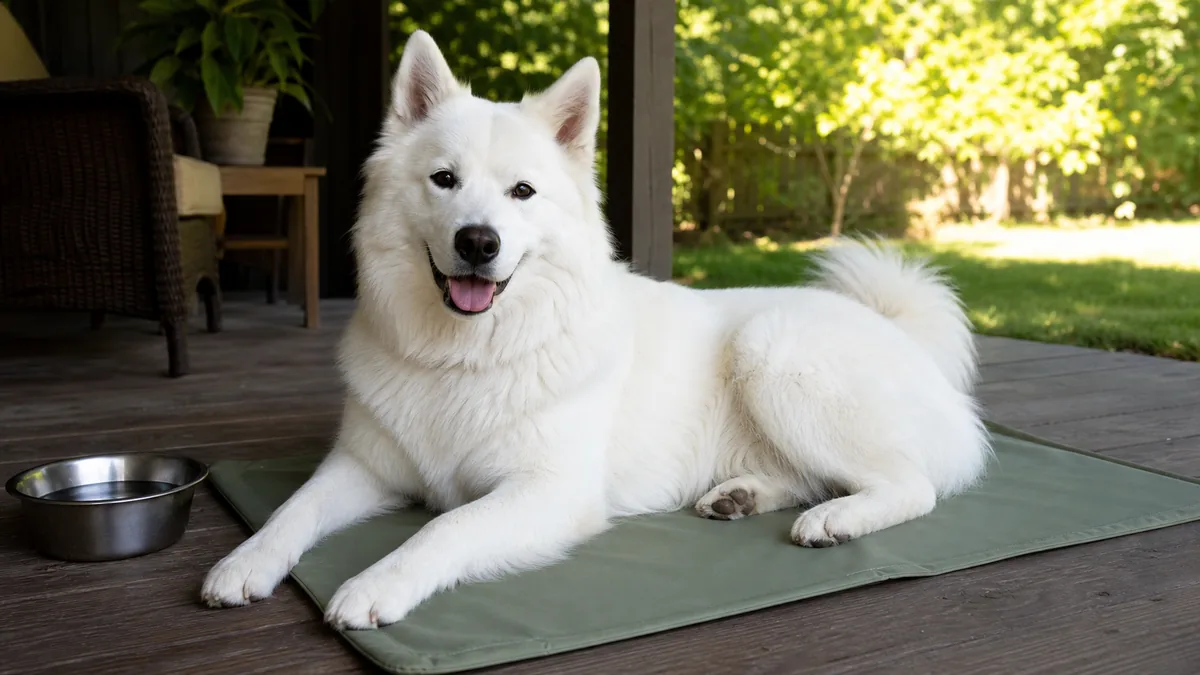
My oldest is a thick-coated Sammy-mix in Dallas. The first summer, 80 percent humidity hit week one and our walks moved to 5:30 a.m. Fourteen months, zero heat events — while a neighbor’s flat-faced dog went to the ER the same week she told me, “Mine handles it.”
Prevention beats treatment every single hot day. This guide walks the heat-index map that decides today’s plan, the six early warning signs, the seven-second pavement test, and the first-five-minutes cool-down if you ever need it.
- 1Why dogs can’t cool themselves like you can
- 2The temperature + humidity map
- 3Six early heat-stroke signs
- 4The 7-second pavement test
- 5Heat emergency — the first 5 minutes
- 6Walk timing that works
- 7Indoor cool-down stations
- 8Hydration upgrades that get drunk
- 9The cooling gear that works
- 10Backyard setup — shade, pool, mister
- 11High-risk dogs — lower the threshold
- 12The car red line
- 13When to call the vet anyway
Why Dogs Can’t Cool Themselves Like You Can (Anatomy + What Counts as Hot)
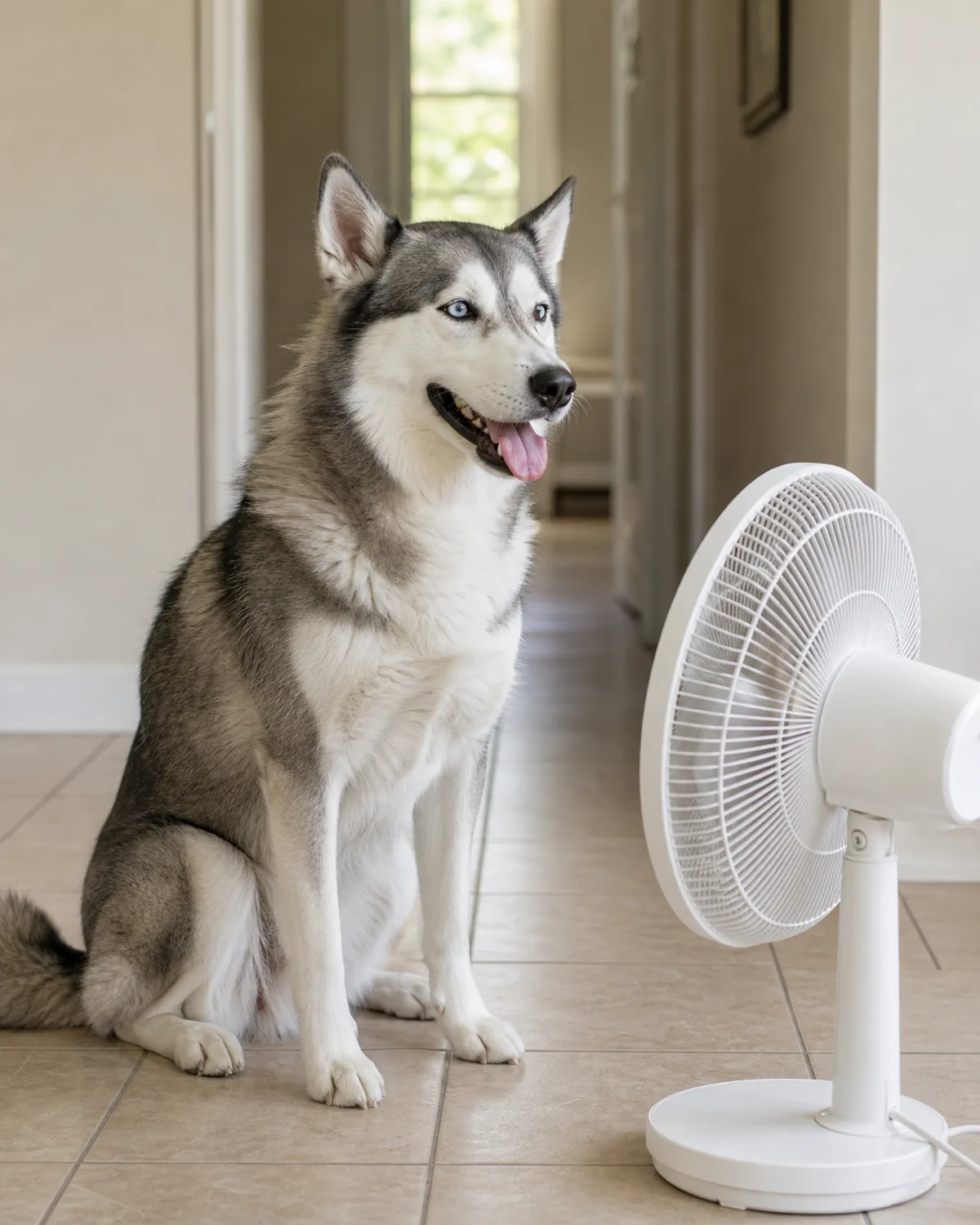
Dogs do not sweat the way you do. They have a few sweat glands in the paw pads and almost nothing across the rest of the body, so the entire cooling system runs through panting and through the soles of four small feet. That is a working setup at 65°F. At 90°F with high humidity, the math runs out fast — humidity blocks evaporation, and panting is mostly evaporation in disguise.
The risk is not evenly distributed. A black short-coated dog absorbs sunlight that a white dog reflects. A heavy double coat traps body heat like a parka. A flat-faced dog has a shortened airway that makes panting genuinely inefficient — not just clumsy, mechanically less effective.
Seniors, puppies, overweight dogs, and any dog with heart or airway history sit one tier hotter than the thermometer says.
The one mistake behind most summer trouble
The single mistake that drives most summer trouble is the human comfort test. You feel fine in shaded 78°F so the dog must be fine. But you are not standing one inch above sun-baked asphalt with a fur coat, and you have a global sweat system.
- Cooling happens through panting and through the paw pads — that is the entire toolkit.
- Black coats, double coats, brachycephalic faces, seniors, puppies, and cardiac dogs need a lower personal threshold than the general rule.
- “I feel fine” is not data about the dog — measure the day, measure the surface, measure the breed factors.
The Temperature + Humidity Map (When Is It Actually Dangerous?)
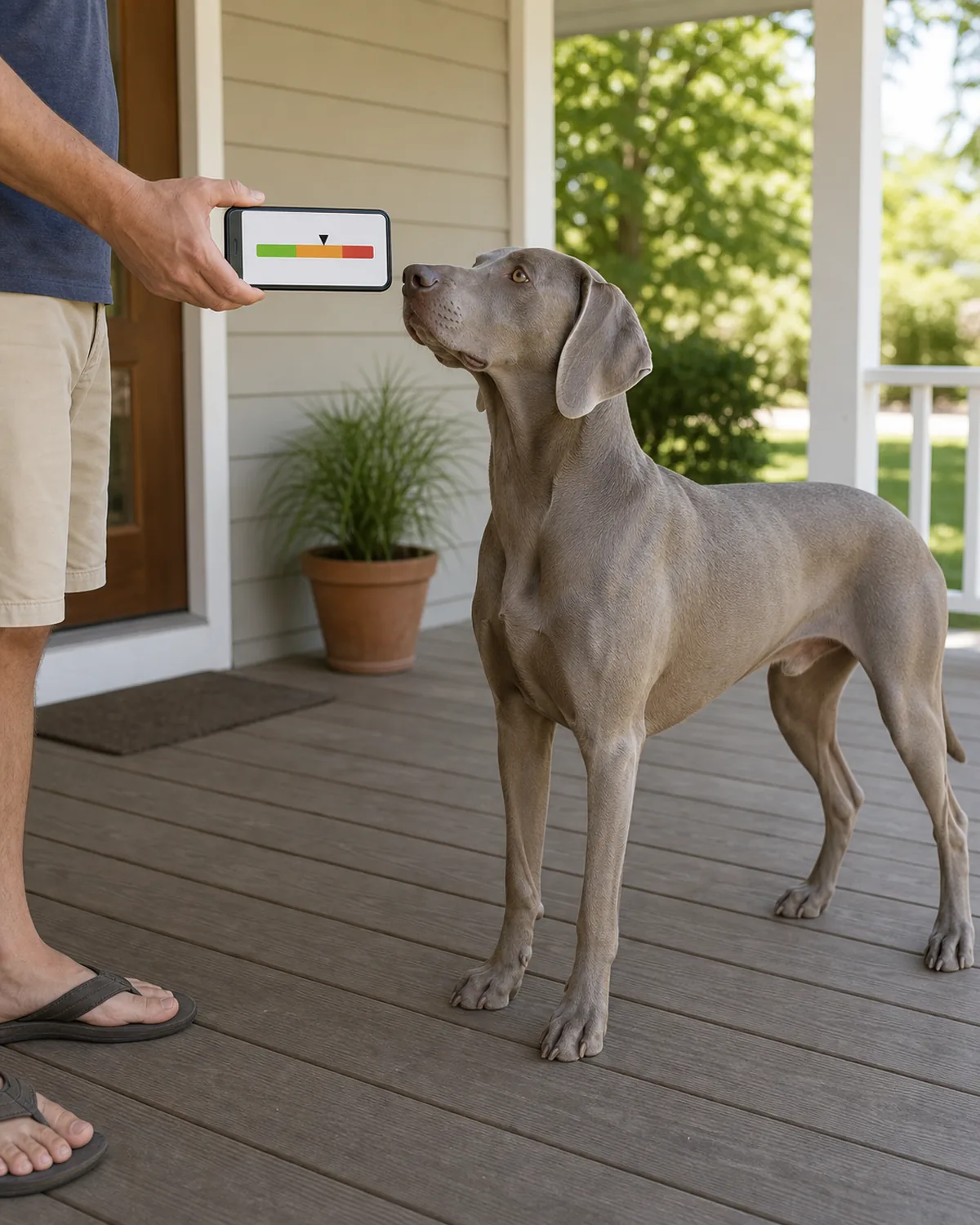
The forecast number on its own is not the decision input. The decision input is the “feels like” or apparent temperature your weather app already calculates — air temperature combined with humidity. 88°F dry and 85°F humid look almost identical on a thermometer and behave like different planets for a panting dog. Read the feels-like, not the temperature.
Once you have that number, three tiers cover almost every day. Below 80°F feels-like is a normal day with no special protocol. Between 80 and 90 is the caution band — cool-window walks, short and slow, indoor enrichment for the rest, water always present. Above 90 is the red band — indoors only, AC on, brief pee breaks at the coolest moments of dawn and dusk on grass not pavement.
Two adjustments make the map honest. High-humidity climates drop every threshold by 5°F because evaporation cannot keep up. High-risk dogs — brachycephalic, senior, heavy-coat, black-coat, cardiac, overweight — drop every threshold another 5 to 10°F. Their safe day is the average dog’s caution day.
- The decision input is the feels-like temperature, not the dry-bulb forecast number.
- Three tiers — safe under 80, caution 80 to 90, red over 90 — cover almost every summer day.
- Humid climates and high-risk profiles each shift the whole map cooler by 5 to 10°F.
Six Early Heat-Stroke Signs (Before It’s an Emergency)
Heat stroke does not arrive as a single dramatic collapse. It arrives as a stack of small “that’s not normal” cues that look ignorable individually and add up to an emergency over fifteen minutes. The owners who catch it early are the ones who know what to look for before the first sign shows up — not the ones who Google it in the moment.
The six signs, in the order you notice them
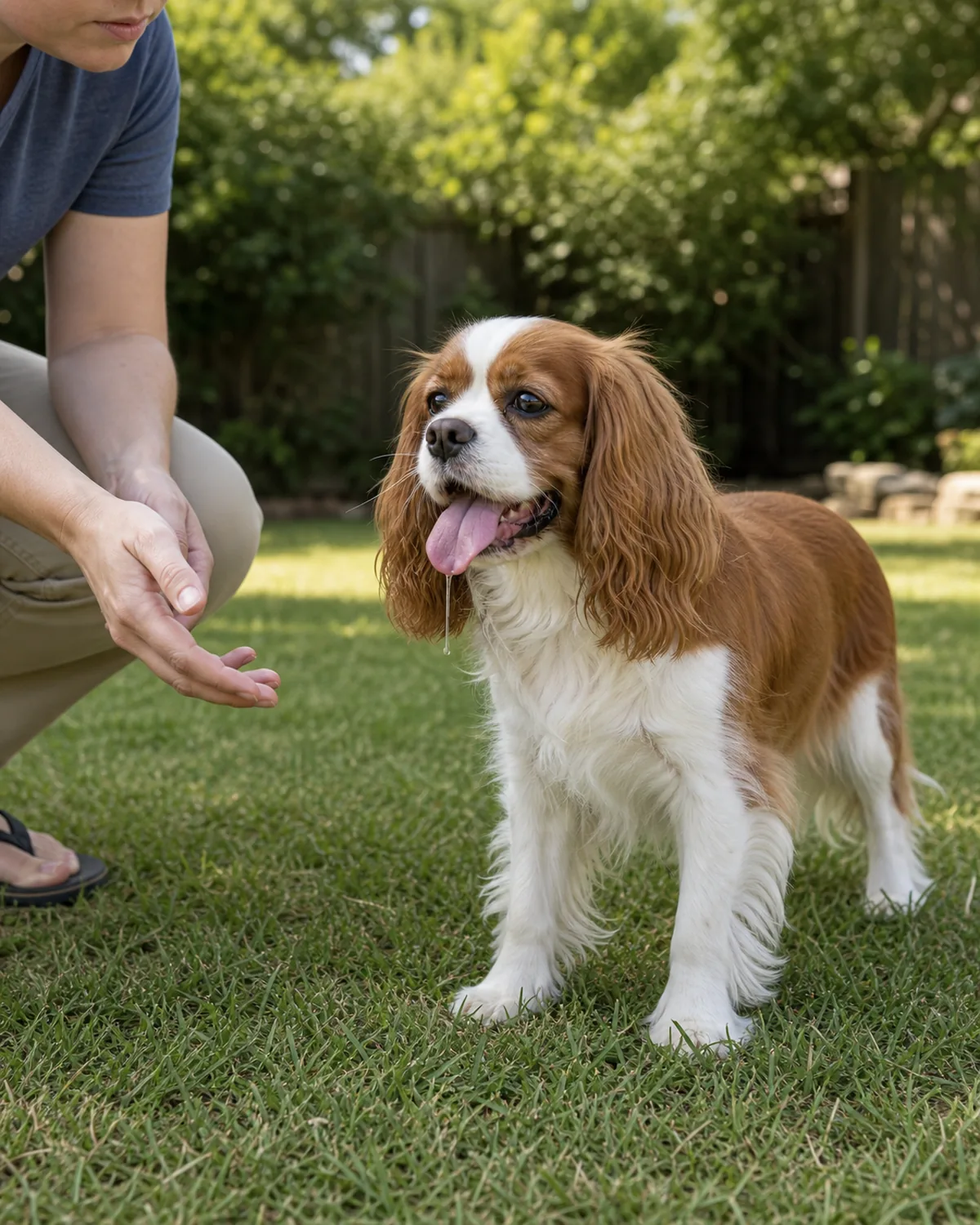
Six early signs cover most of what you will ever see. Heavy panting that will not settle after a full two minutes of rest. Sticky, stringy, ropey drool instead of the normal thin clear cool pant. Gums that look brick-red and angry, or oddly pale and grey-pink instead of soft healthy pink. A wobbly gait or stumbling on flat ground.
Going dull and unresponsive, slow to react to their own name. Sudden retching or vomiting with no other explanation.
This list is not a diagnosis. It is the trigger for the cool-down sequence in the next section and a vet call on the way. Prevention beats treatment, and recognition beats panic — if any one sign appears, you stop the activity right then and start cooling. Two signs together means you skip the wait and call now.
- Watch six early signals: heavy unresolved panting, sticky drool, abnormal gum color, wobble, dullness, sudden vomiting.
- One sign appears — stop the activity, move to shade, start cooling, call the vet.
- Two or more signs appear together — start cooling immediately while someone else dials the vet.
The decision is not “does it feel hot to me.” It is the apparent temperature (air temp combined with humidity) that your weather app already shows as “feels like.” Read that number, then drop your dog into the matching tier below.
The 7-Second Pavement Test (and the Paw-Pad Reality Check)
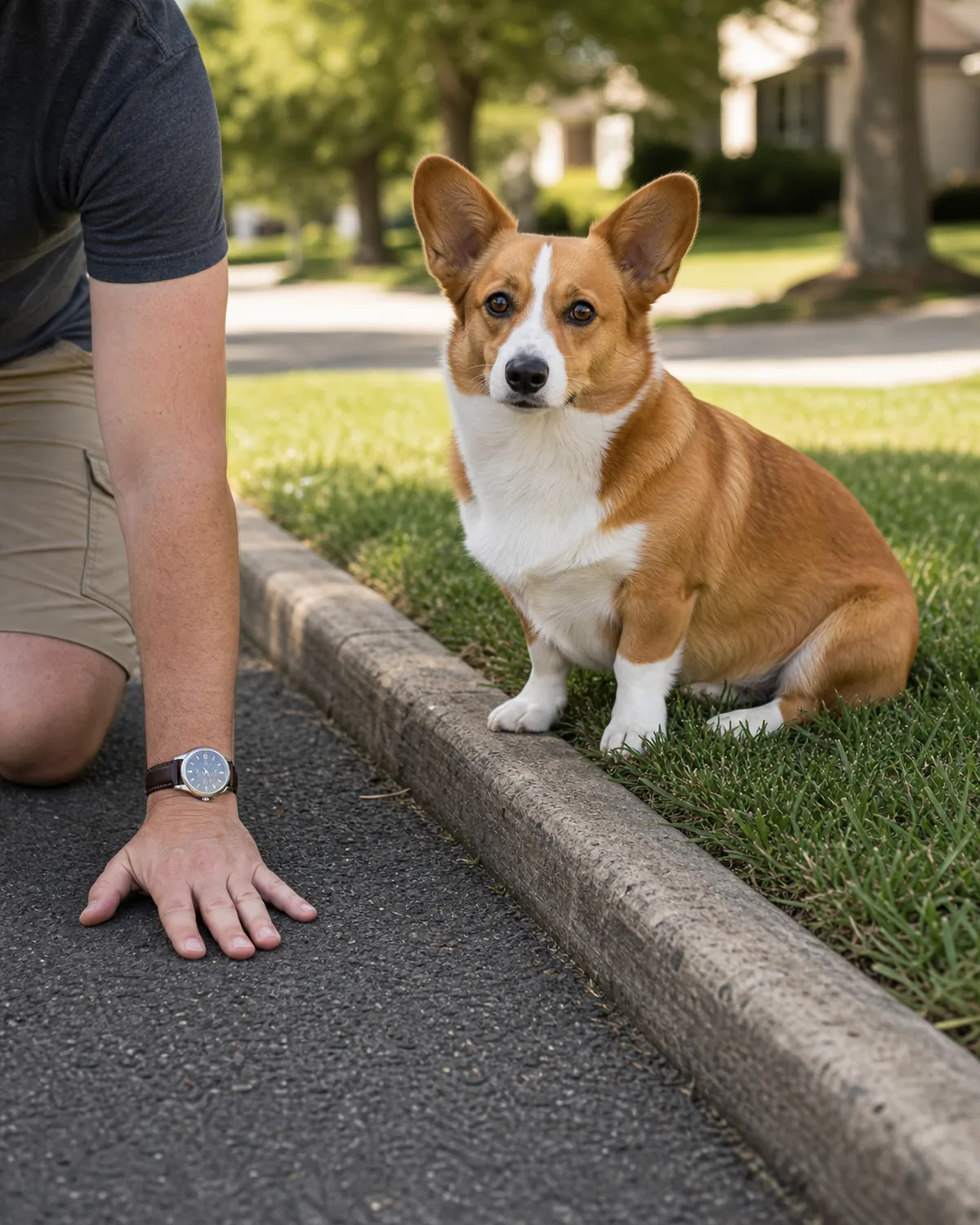
Air temperature and surface temperature are not the same number. On an 86°F afternoon, dark asphalt routinely measures 135°F, sand sits in the same neighborhood, and a black metal manhole cover or truck-bed surface can run hotter than a stovetop. The forecast says hot. The ground says burn.
The seven-second pavement test is the cheapest paw-pad check you can run, and it works for almost any surface. Press the back of your hand flat against the asphalt, the sidewalk, the wood deck, the trailer floor, or the parking lot for a full seven Mississippis. If you cannot hold it, your dog cannot stand on it. Skip the surface, pick grass, or move the activity to the next cool window.
Burns on a paw pad start at redness, escalate to blisters that look like little white domes, peel to raw pink skin, and the dog licks the raw skin which seeds infection. The vet treatment is days of bandage changes, often antibiotics, and a frustrated bored dog. The prevention is one seven-second check and the boring choice to walk on grass.
- Surface temperature is wildly different from air temperature — sun-baked asphalt can run 50°F hotter than the forecast.
- Run the back-of-hand seven-second test on the actual surface — if you cannot hold it, the dog cannot.
- Carrying a small dog from car to grass to skip the parking lot asphalt is not coddling, it is paw care.
Heat Emergency: The First 5 Minutes (Cool Water, Not Ice; Body, Not Head)
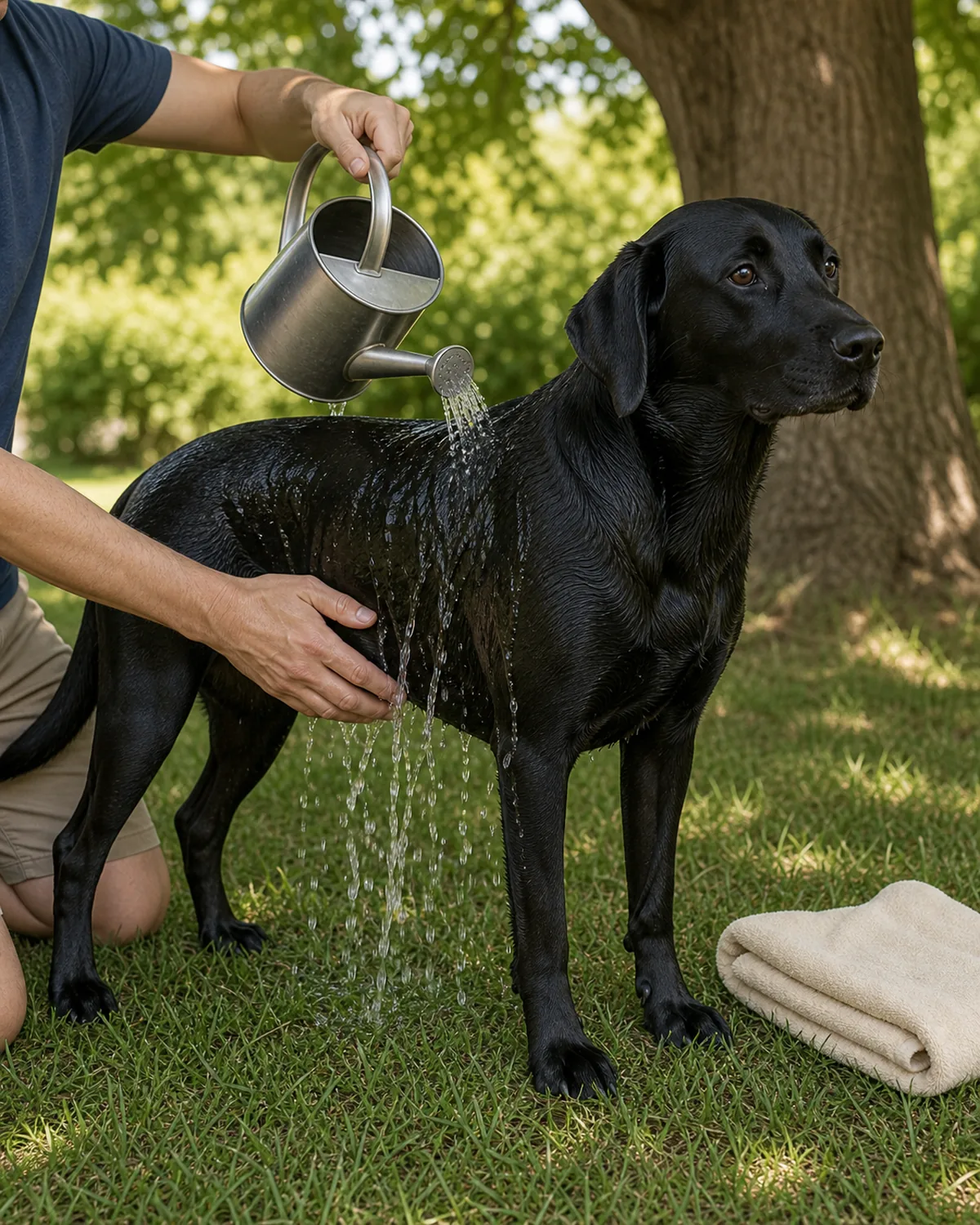
If a sign from section three shows up, the first five minutes decide most of the outcome. The single most common owner mistake is ice — ice bath, ice bucket, ice pack pressed to the fur. Ice triggers blood-vessel constriction at the skin, which traps core body heat where it does the damage, while making the temperature reading at the surface look reassuringly normal.
Cool water (60 to 77°F, plain tap), not ice. Body, not head. Armpits and groin first.
The five-step cool-down, in order
The five-step sequence runs about ninety seconds once you have done it once. Move the dog to shade or indoor AC immediately and stop all movement. Pour cool water over the back, sides, armpits, groin, paw pads, and under the jaw — the places where major blood vessels run shallow.
Add a fan or a cross-breeze so the wet coat actually evaporates instead of sitting warm against the skin. Lay a cool wet towel against the neck and inside the ear flaps, but never push anything into the ear canal. Call the vet while you cool.
Cool water, not ice. Body, not head. Armpits and groin, not the back of the neck only. This combination is the entire emergency protocol most owners are missing — and the reason ice baths still hurt dogs every July.
- Cool water (60 to 77°F) over body and limbs — never ice, never frozen items pressed against fur.
- Wet plus a breeze equals real cooling — a wet dog in still air just stays warm and damp.
- Call the vet while cooling — do not finish cooling first, do not wait for “is this an emergency” certainty.
Walk Timing That Works (Golden Windows + Skip-Day Math)
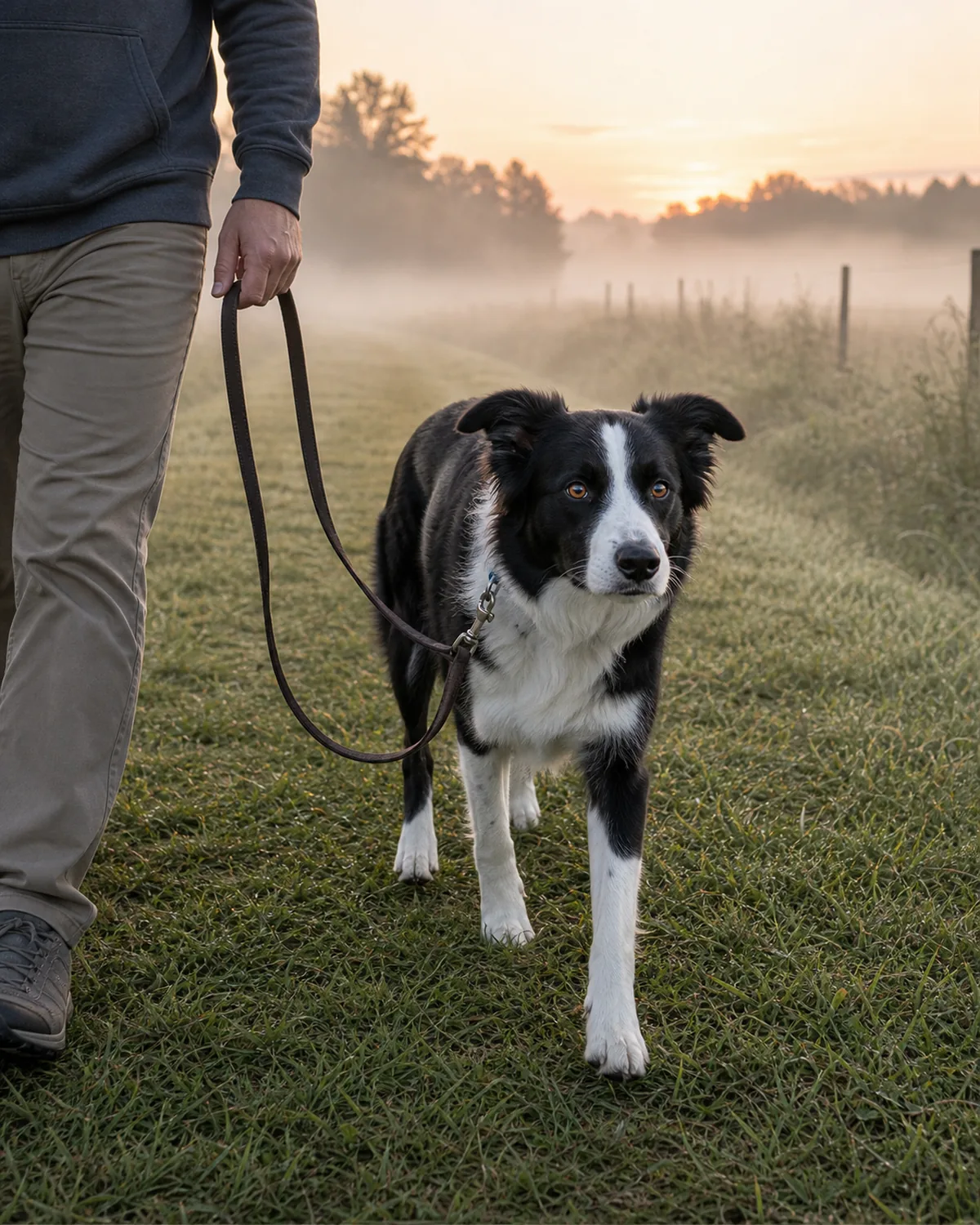
Heat season is timing season. Two windows do almost all the safe outdoor work — the pre-dawn hour through about thirty minutes after sunrise, and the hour starting roughly sixty minutes after sunset. The asphalt and the air are both at their daily minimum, the sun is off the dog, and a forty-five minute walk in those windows is calmer than a fifteen-minute walk at noon.
The middle of the day is for indoors.
That redistribution does not mean the day’s exercise budget shrinks by half.
Where the skipped walk’s exercise should go
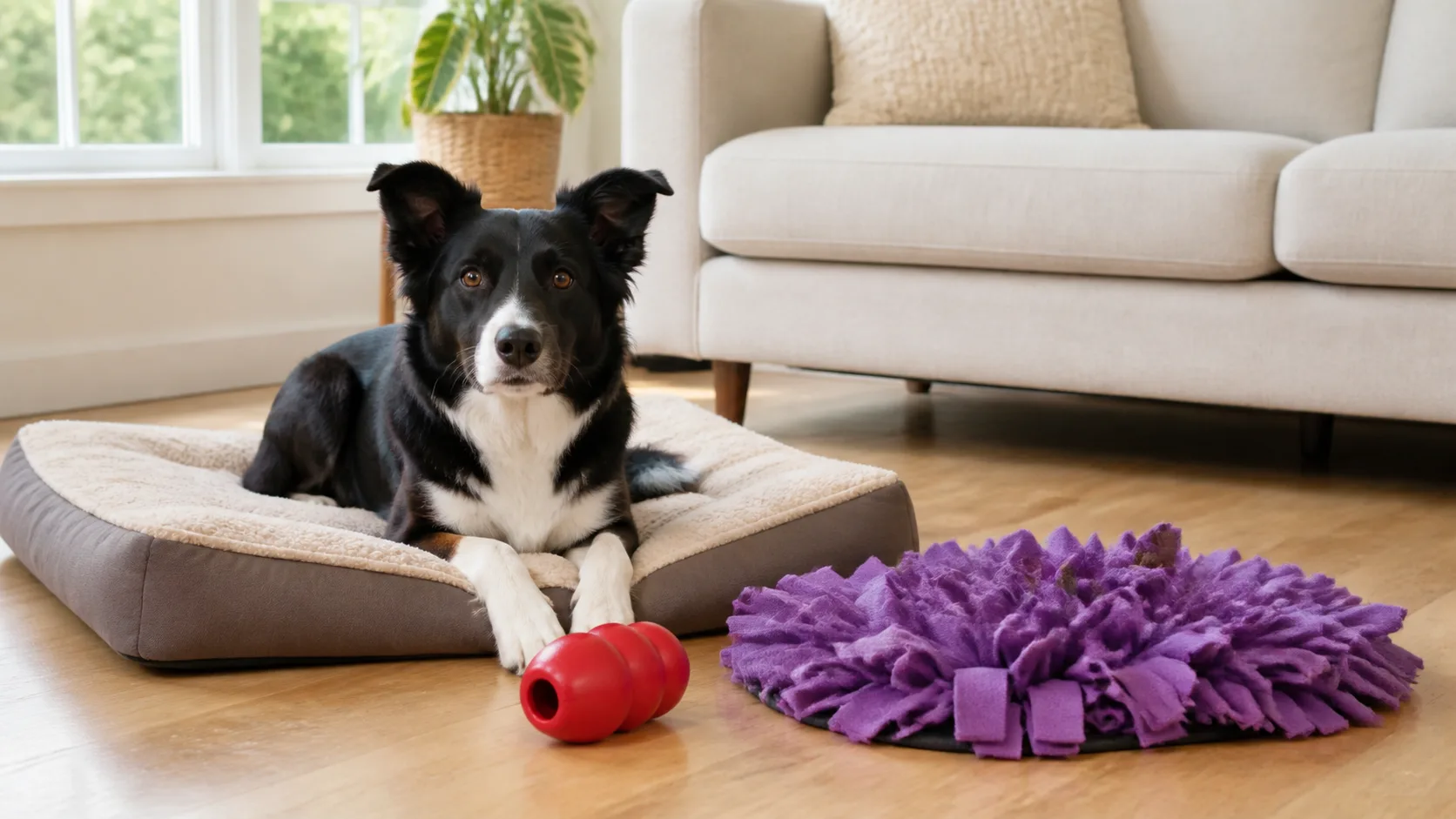
The size-and-age dosage math from our walking-time guide still applies — you are just redistributing those minutes into the cool windows, and the rest gets replaced by indoor enrichment that actually tires a dog (a snuffle mat, a frozen lick mat, a training session, a puzzle toy).
Cut the budget by half and you will pay for it in renovated furniture by week two.
The version of this that fails is “we will go later when it cools down” — translated, the walk does not happen because life moves on. The version that works is alarm-set, shoes-by-door, dog already out the door before the kitchen kettle goes on.
Or the after-sunset version is on the calendar as a non-negotiable, not an “if we feel like it.” Heat season is timing season precisely because hesitation eats the window.
- Two golden windows do almost all the safe walking — pre-dawn out to thirty minutes past sunrise, and one hour after sunset.
- Redistribute the dosage from the exercise guide into those windows — do not amputate it.
- Indoor enrichment (snuffle mat, lick mat, training session, puzzle toy) covers the missing midday minutes.
Almost every preventable heat incident comes from a violation on the right side of this card. Read both columns once before the first 80°F day, then trust them.
Always Do
- Check the feels-like temperature before any walk or yard session and pick a tier.
- Carry fresh water on anything longer than a short pee break, even in caution weather.
- Use cool tap water (60–77°F) for any active cool-down, not cold and never frozen.
- Watch the dog for a calm twenty-four-hour window after any real heat exposure event.
- Set up structural shade in the backyard — a shade sail beats a beach umbrella every time.
- Bring the dog out of any parked car every single time, no matter how short the errand.
Never Don’t
- Submerge the dog in an ice bath or ice bucket — blood vessels constrict and trap core heat.
- Press an ice pack or frozen bottle directly against skin or fur during a cool-down.
- Leave a dog in a parked car for even one minute, cracked window or full AC running.
- Assume “just panting” means “still fine” once the panting will not settle within two minutes.
- Skip a vet call after a real heat-exposure event — delayed organ effects show up within a day.
- Shave a heavy double coat down to the skin — the undercoat is insulation against the sun.
- Tell yourself “my dog has always handled it before” — that is not a fact, it is a habit.
Indoor Cool-Down Stations (Shaded Floor, Cooling Mat, Frozen Lick Mat)
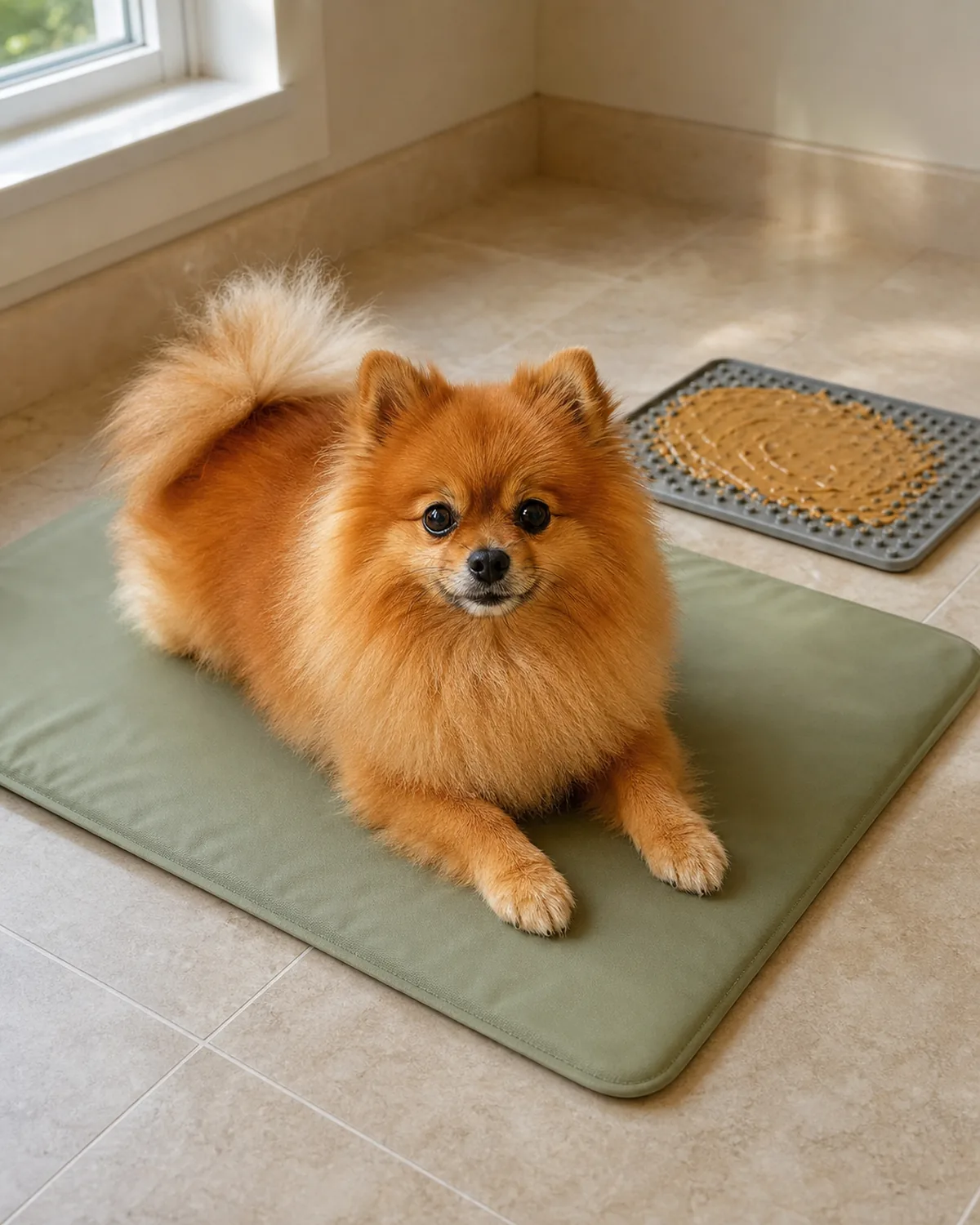
Indoor cool-down does not require expensive gear, and stacking three cheap stations beats one premium gadget. The whole point is to give the dog optionality — different surfaces for different moods, so there is always one cool place to land. Most homes already have two of the three.
Station one is the tile or stone floor most kitchens, bathrooms, and entryways already own. It is the coldest passive surface in the house, free, and most dogs naturally migrate there in summer if you leave the door open. Station two is a self-activating gel cooling mat — body weight presses on the gel to release the cooling effect, no freezing required.
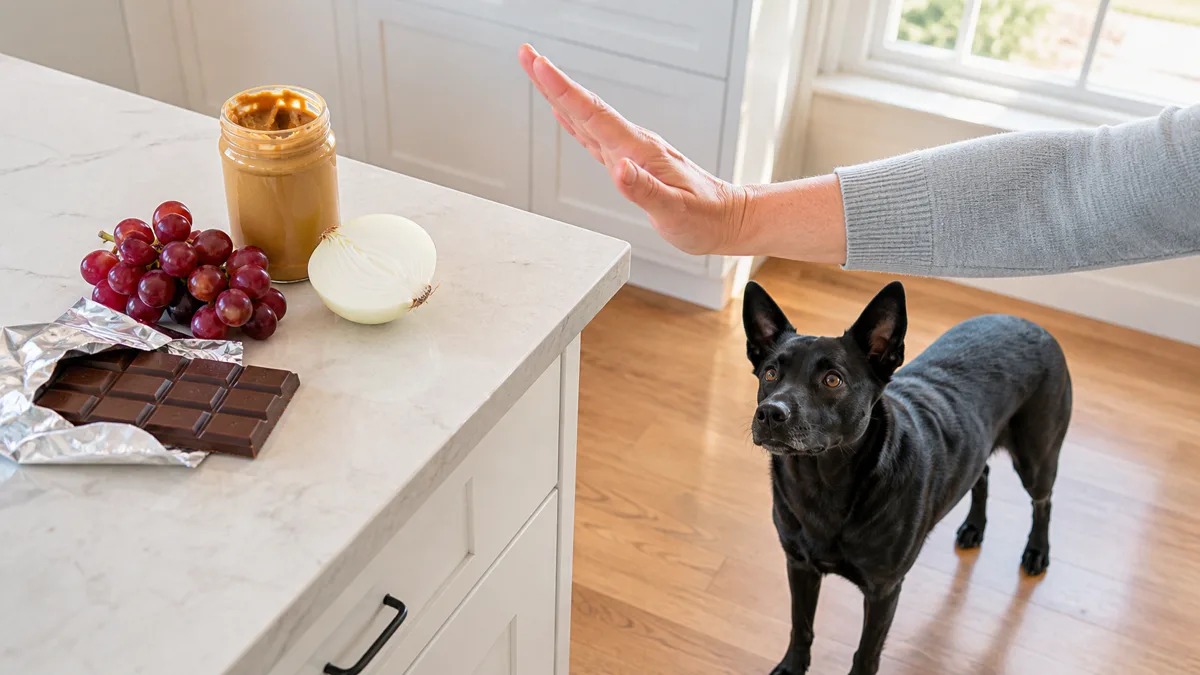
Worth it only if your dog will actually lie on it (a thick-coated dog who refuses the mat is just paying rent on furniture). Station three is a frozen lick mat — smear a thin layer of unsalted bone broth and a small amount of plain unsweetened peanut butter onto a rubber lick mat and freeze for thirty minutes.
Add a second and third cool-down spot
Thirty more minutes of focused calm, plus a slow trickle of hydration.
Place the three stations in different rooms. Dogs cool by relocating — they are not loyal to one mat. If three options are within their normal home loop, they will use them on their own schedule, and you will stop worrying.
- Tile floor is the cheapest cooling station and most homes already have one — open the door to it.
- A gel cooling mat is body-weight activated and works without freezing, but only if the dog actually lies on it.
- A frozen lick mat with broth and a small amount of peanut butter buys thirty calm minutes plus slow hydration.
Hydration Upgrades That Actually Get Drunk (Beyond the Water Bowl)
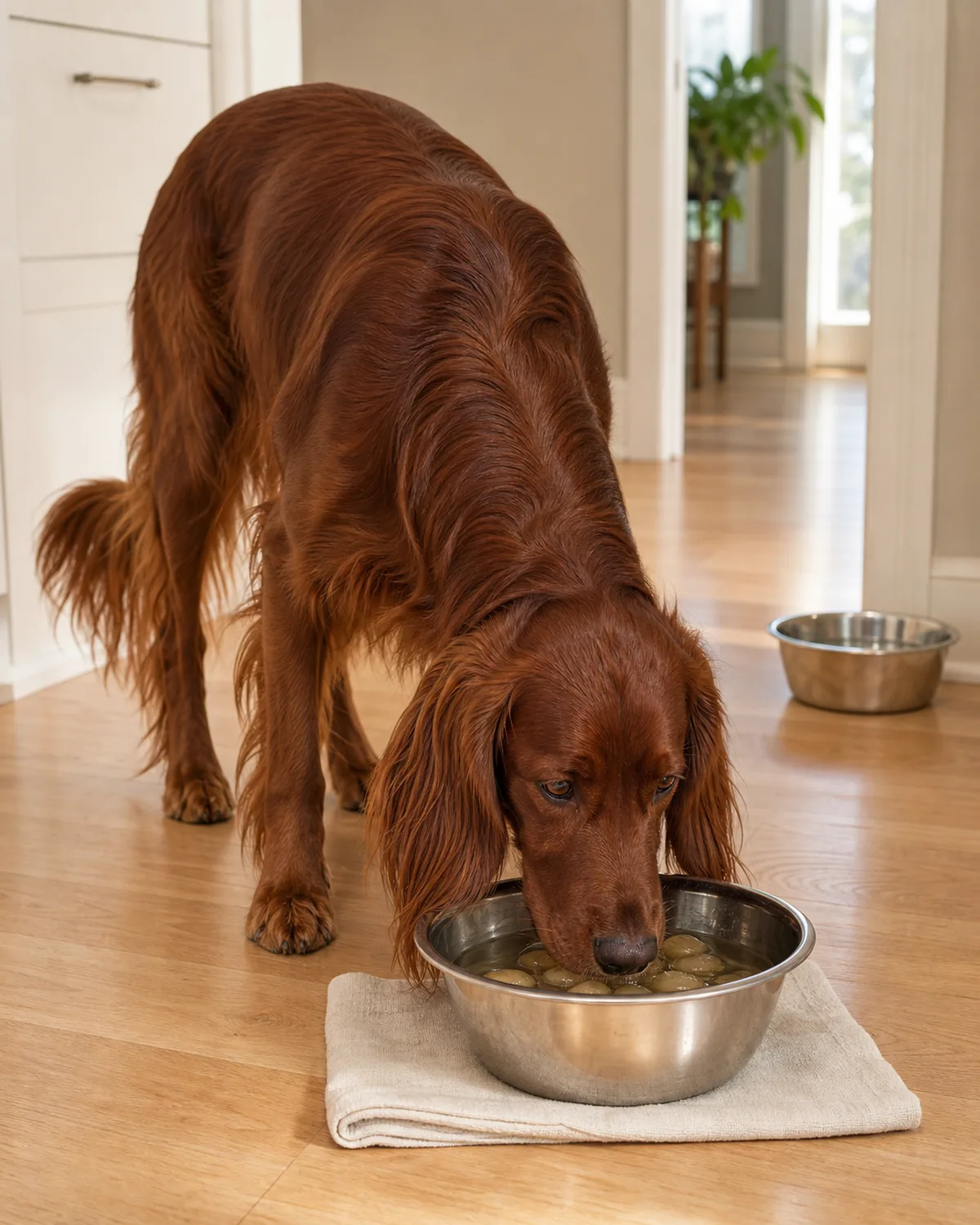
The “I keep filling the bowl and she barely touches it” problem is almost never a desire problem. It is a friction problem. Water that is far away, lukewarm, sitting in one spot, smells like nothing, and has the same texture all day is exactly as appealing as it sounds. What works is offering more options that are slightly more interesting.
Four upgrades change the curve. Add bowls in every room the dog frequents plus one in the shaded part of the yard — proximity raises consumption more than any other variable.
Float clear-amber broth-ice cubes (unsalted bone or plain chicken broth, frozen plain in an ice tray) on the surface of the water; most dogs will drink the broth water aggressively when they ignore plain ice. Add a moving-water fountain if a dog responds to sound and motion.
Mix a tablespoon of warm water into each meal so dry kibble carries fifty extra millilitres of fluid into the day automatically.
A ten-second dehydration self-check
A quick dehydration self-check pays for itself: pinch the loose skin between the shoulder blades, lift it gently, and let go. Healthy skin snaps back instantly. A delayed return of more than three seconds is the early flag — offer cool water in small frequent sips and call the vet if it persists past an hour.
- Multiple bowls in multiple rooms plus one outside is the single highest-leverage hydration upgrade.
- Broth-ice cubes in the bowl get drunk far more reliably than plain water or floating plain ice.
- The skin-snap test on the shoulder blades is the home dehydration check — over three seconds back is the early warning.
The Cooling Gear That Works (Vests, Mats, Bandanas — and One That Doesn’t)
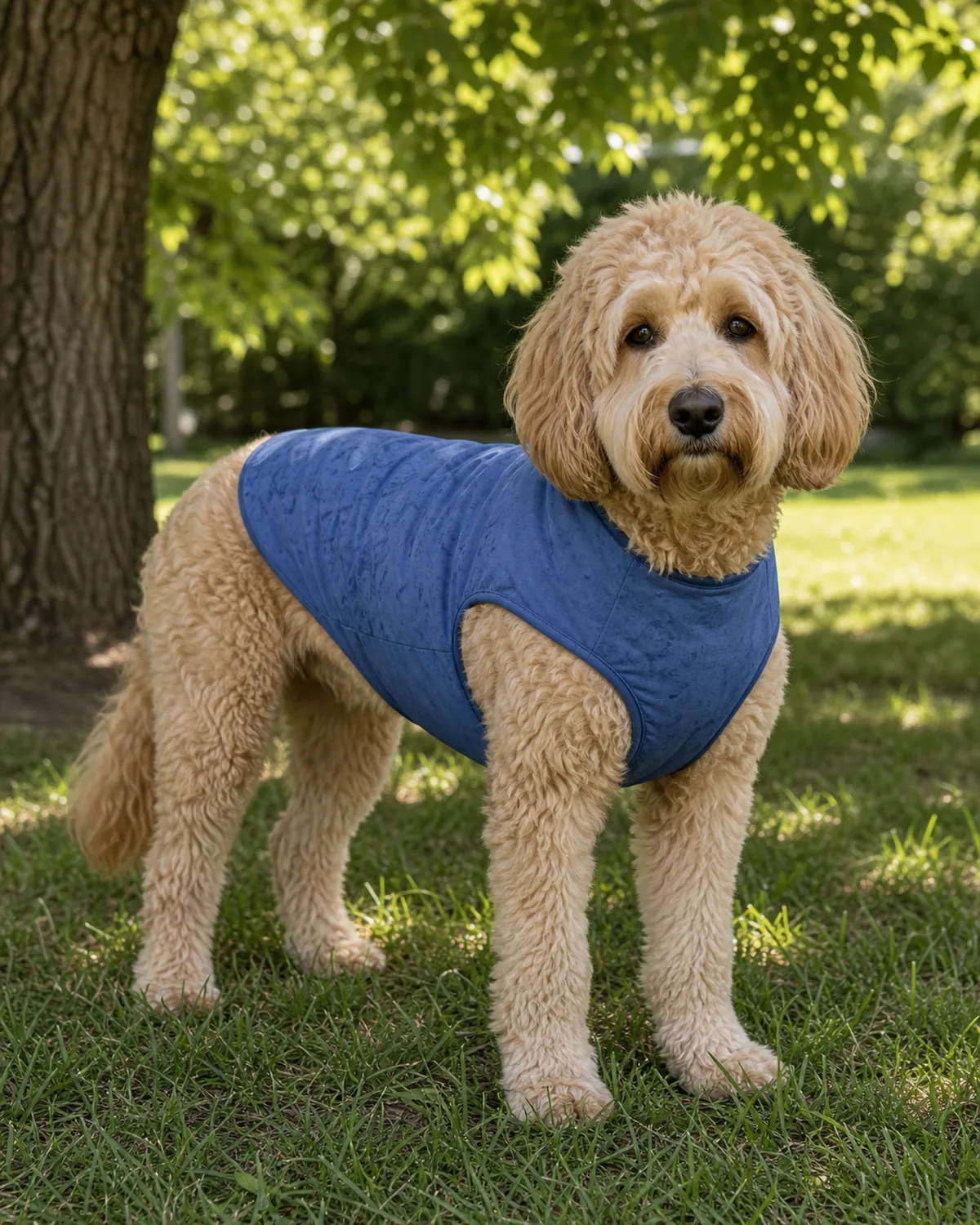
Most of the cooling-gear aisle is marketing. Three categories actually work, and one extremely common product makes things worse. Naming them all in one place saves a hundred dollars.
What works: an evaporative cooling vest in a dry climate — soak, wring, snug it on, and evaporation off the wet fabric pulls heat from the dog for thirty to forty-five minutes. A gel cooling mat indoors as discussed in section seven.
A cooling bandana or neck wrap soaked in cool water and chilled briefly — the carotid arteries run shallow there, so a small cool patch buys real systemic cooling for a half hour. What does not work: any vest packed with ice beads or frozen gel inserts.
The math is wrong (localized frostbite risk on contact), the weight is wrong (heavy enough that the dog overheats wearing it), and most dogs reject it within a minute anyway.
The upstream move: deshedding, not shaving
One bonus upstream move worth knowing — and this is where summer planning gets earned in May. A late-spring deshedding session with the right brush — see our brush-resistant-dog guide for the gentlest approach — drops the undercoat heat load before the first 90°F day arrives.
Less stored heat through July is real. Never shave a double coat down — that strips the insulating layer and adds sunburn risk on top of heat.
- Three things work: evaporative vest in dry climates, gel mat indoors, cooling bandana on the neck.
- Ice-bead vests fail on three fronts — frostbite contact, heavy weight, and dog rejection.
- Late-spring deshedding (not shaving) lowers the heat load you carry into July, see the brush guide.
The Hot-Day Cheat Card
Read the day
7-Second Pavement Test
- Place the back of your hand flat on the asphalt for a full seven seconds.
- If you cannot hold it, your dog’s paw pads cannot either — pick grass or wait.
6 Early Heat-Stroke Signs
- Heavy panting that will not settle after two rest minutes
- Sticky, stringy, ropey drool (not the normal clear pant)
- Brick-red or unusually pale grey-pink gums
- Wobbly gait, stumbling, falling behind on flat ground
- Dull, unresponsive, slow to answer their own name
- Sudden retching or vomiting with no other explanation
If anything is off
First 5 minutes cool-down
- Move into shade or AC immediately — stop all movement.
- Pour cool water (60–77°F) over body — armpits, groin, paw pads, under the jaw.
- Add a fan or a steady breeze for evaporative cooling.
- Lay a cool wet towel against the neck and inside the ear flaps — not in the canal.
- Call the vet while cooling — head in if anything is unclear.
Vet now — red lines
- Core temp at or above 104°F
- Collapsed, cannot stand, unresponsive
- Any blood, or red-brown / cola-colored urine
- Dull or off twenty-four hours after the event
- Refusing to drink water more than a few hours
pawliqa.com
Backyard Setup: Shade, Pools, Misters (Without Lawn Drama)
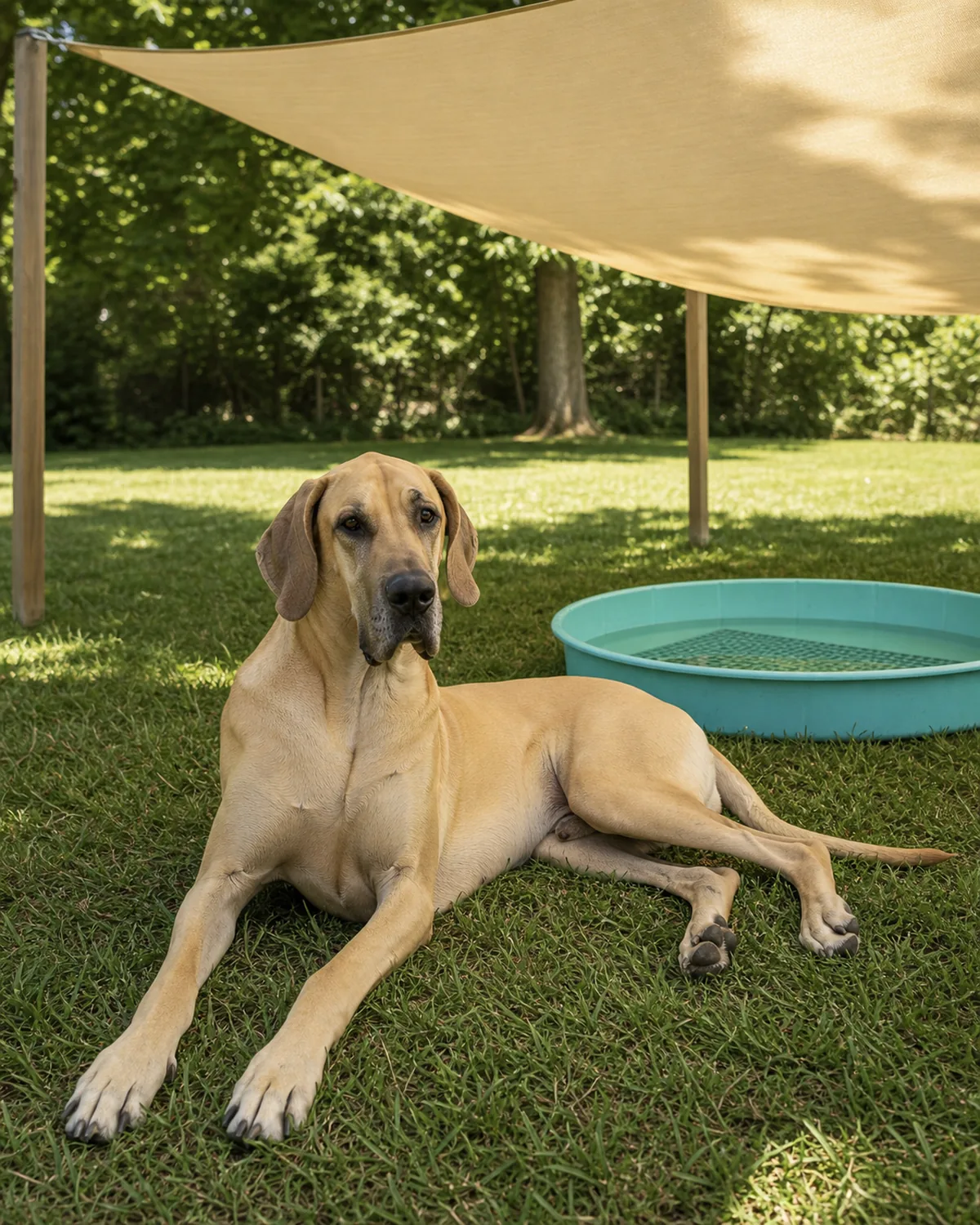
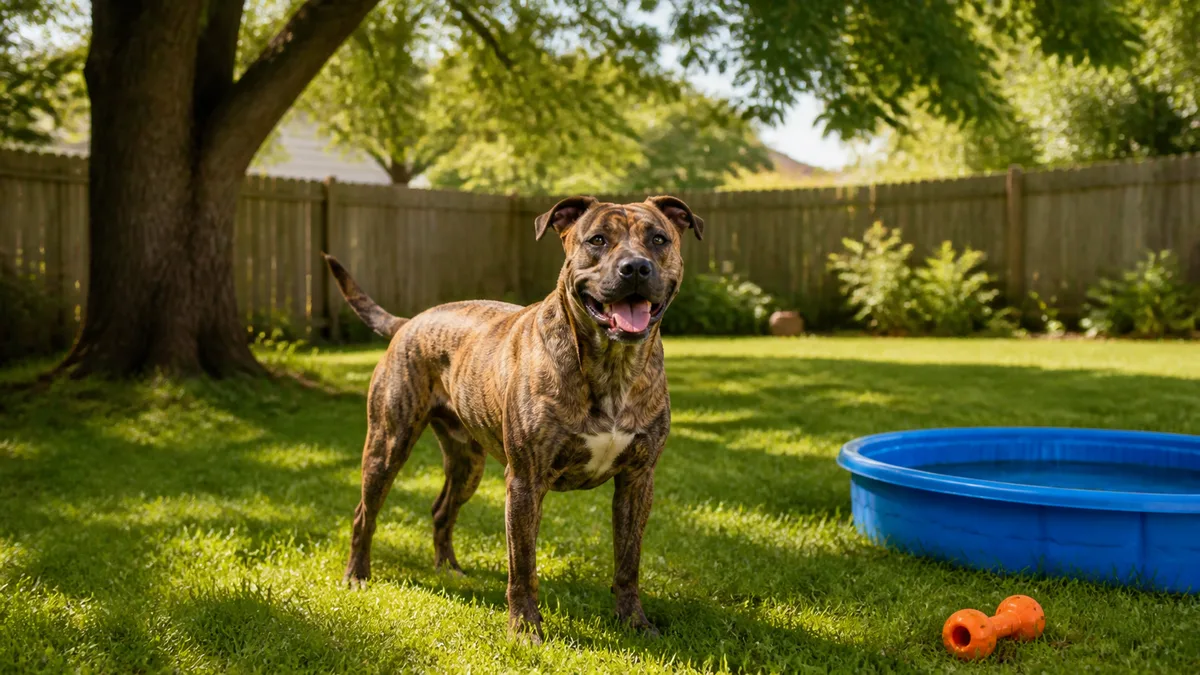
Backyard cooling is mostly a structural problem, not a gadget problem. The single biggest upgrade you can make is structural shade — a shade sail stretched between two anchor points, a covered patio, or an awning that does not move when the sun moves. A patio umbrella covers a square metre and tracks the sun all afternoon, which means the dog ends up sitting in sun by 3 p.m.
anyway. Cover a real area, and you have changed the yard.
Pools and misters that earn their keep
A shallow kiddie pool earns its keep, with one detail most owners miss. Water depth should be six inches or under — this is for paw and belly cooling, not for swimming, and a deeper pool gets unstable when a large dog steps in. A non-slip rubber mat on the bottom of the pool stops the slipping-and-panicking moment that turns the pool into a one-time-only experiment.
Empty and refill every day or two in summer — stagnant pool water grows algae fast.
A mister loop earns its keep in a dry climate and actively hurts in a humid one. Misters cool by evaporation, and evaporation is already maxed out in a humid backyard. In a humid climate, swap the mister for an outdoor fan in deep shade.
After any pool play, sit the dog in shade for ten minutes before going back into a cold AC house — the temperature swing can trigger respiratory grumpiness in some dogs.
- Structural shade — a shade sail or covered area — is a bigger upgrade than any gadget you can buy.
- A kiddie pool works only with shallow water (six inches max) and a non-slip mat inside.
- Misters work in dry climates and fail in humid ones — use a shaded outdoor fan instead in humid weather.
High-Risk Dogs: Brachycephalic + Senior + Heavy-Coat + Black
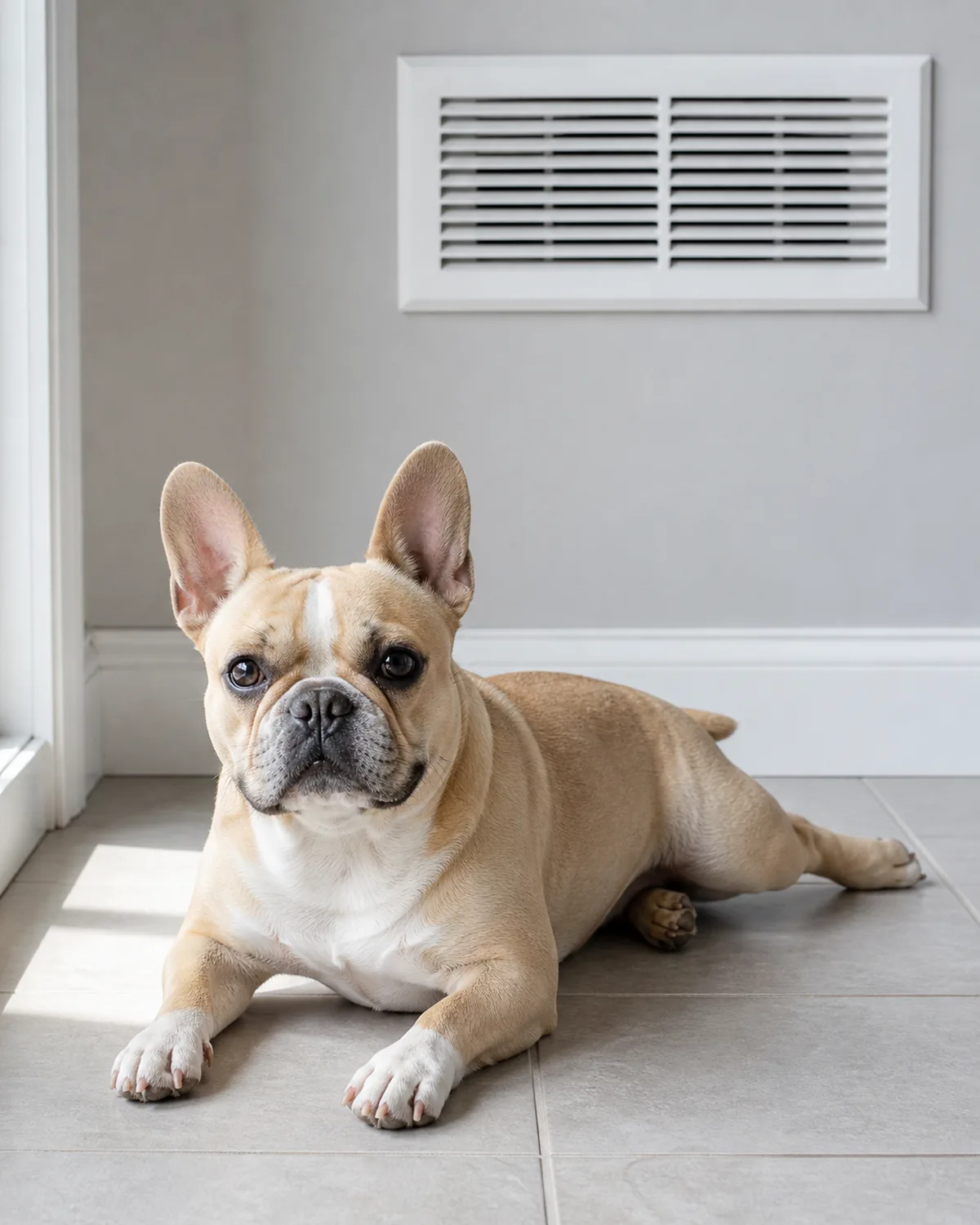
Five profiles need a tighter heat protocol than the general rule, and any dog that fits one of them gets the whole map shifted cooler by 5 to 10°F. The flat-faced dogs — brachycephalic — have a short airway that makes panting genuinely inefficient. Heavy double-coated dogs trap body heat. Black-coated dogs absorb sun. Seniors lose cardiac reserve every year.
Cardiac or overweight dogs cannot deliver oxygen well enough to compensate for heat stress.
The protocol changes for each high-risk profile
Specific protocol overrides matter. A brachycephalic dog’s caution day is most dogs’ red day — over 80°F feels-like is already indoors-only territory. A senior dog’s outdoor exercise budget drops by about thirty percent each summer, and naps in the AC are not laziness, they are heat strategy.
A heavy double-coated dog needs a reliable AC house and free-choice cool water, full stop — and never shaved (the undercoat is insulation). A black-coated dog walks one cool window earlier than the family’s other dogs.
The trap is the “always handled it” sentence — what was true last summer is not necessarily true this summer. Dogs age, gain weight, develop subclinical heart and airway issues. Recalibrate the personal threshold every spring before the first hot day. Prevention beats treatment, and the dogs in this section are the ones where prevention pays for itself five times over.
- Five profiles get the whole map shifted 5 to 10°F cooler: brachycephalic, senior, heavy-coat, black, cardiac or overweight.
- Specific overrides: brachy = indoors at 80, senior = thirty percent exercise cut, double-coat = AC required, black-coat = earliest window only.
- Recalibrate every spring — last year’s tolerance is not a guarantee for this year.
The Car Red Line (Why “Cracked Window” Is Still Deadly)
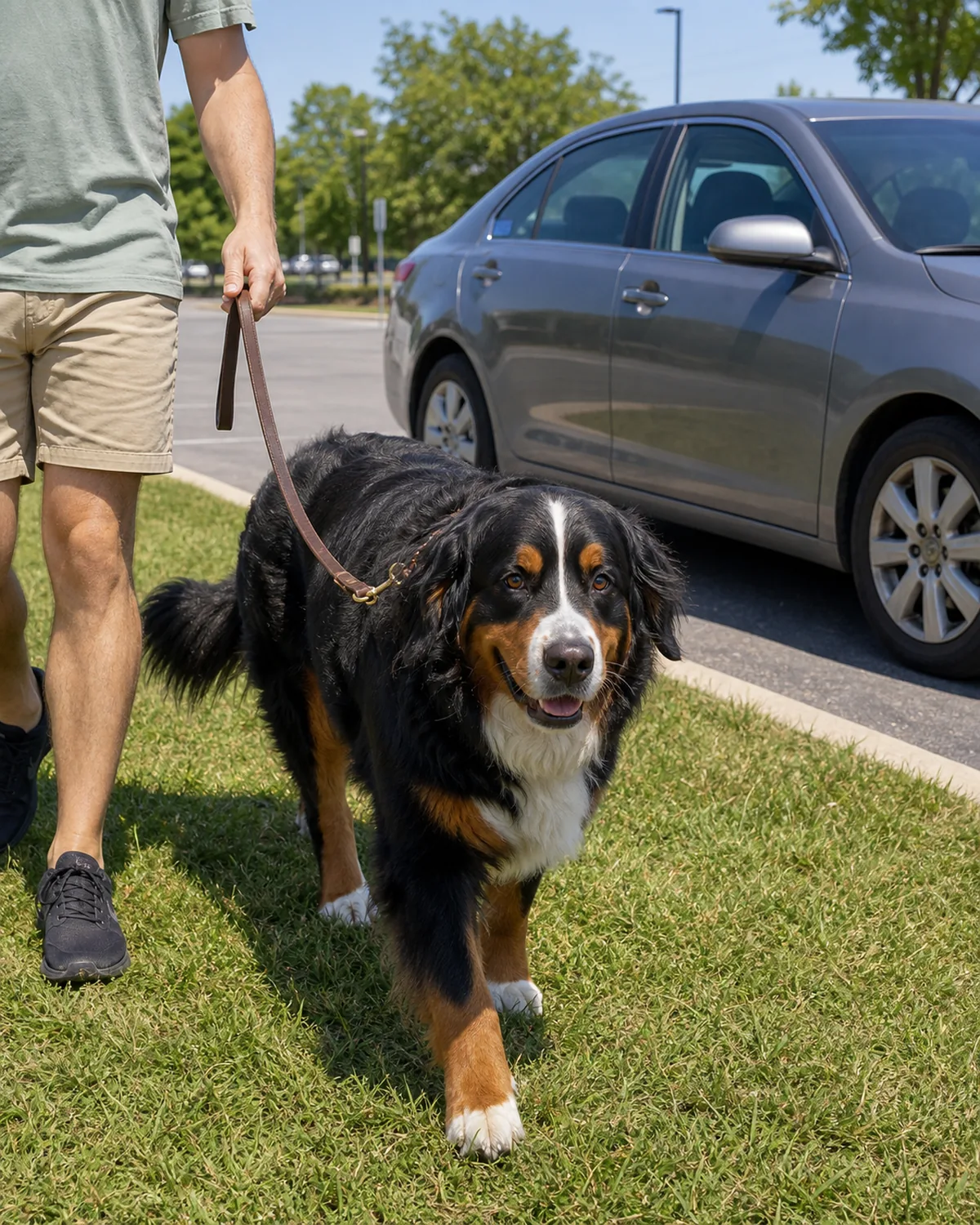
The car number every dog owner should know by heart. Outside temperature 70°F, ten minutes inside the parked car 89°F, thirty minutes 104°F. Outside 85°F, ten minutes 102°F, thirty minutes 119°F. A cracked window does almost nothing — two inches of opening reduces the thirty-minute number by under five degrees.
Leaving the engine running with AC on is not a backup plan either; AC compressors fail without warning and a dog inside a hot car with broken AC is dead within minutes.
The red line is binary and the language has to be unforgiving: never inside a parked car, even one minute, no exceptions. The five-minute ATM stop, the three-minute convenience-store run, the one-minute mailbox pickup — all of them mean the dog comes out. Take the dog with you, take the dog home first, or skip the errand. There is no clever middle option.
If you see a dog locked in a hot car
If you see a dog locked in a parked car on a hot day, call 911 — most U.S. states now have laws that authorize bystanders to break a window within reasonable cause once authorities are notified, and you will not be charged with property damage.
Find the car’s owner if a paged announcement is fast (storefront pages a vehicle and color), stay with the car, and document the time and temperature. Saving a dog this way is not paranoia; it is the system working.
- Memorize the math: 70°F outside = 104°F inside in thirty minutes; 85°F outside = 119°F.
- A cracked window does almost nothing — never inside a parked car, even one minute, no exceptions.
- A locked dog in a hot car warrants a 911 call — most states authorize bystander rescue once notified.
When to Call the Vet (Even if Your Dog “Seems Okay” After Cooling)
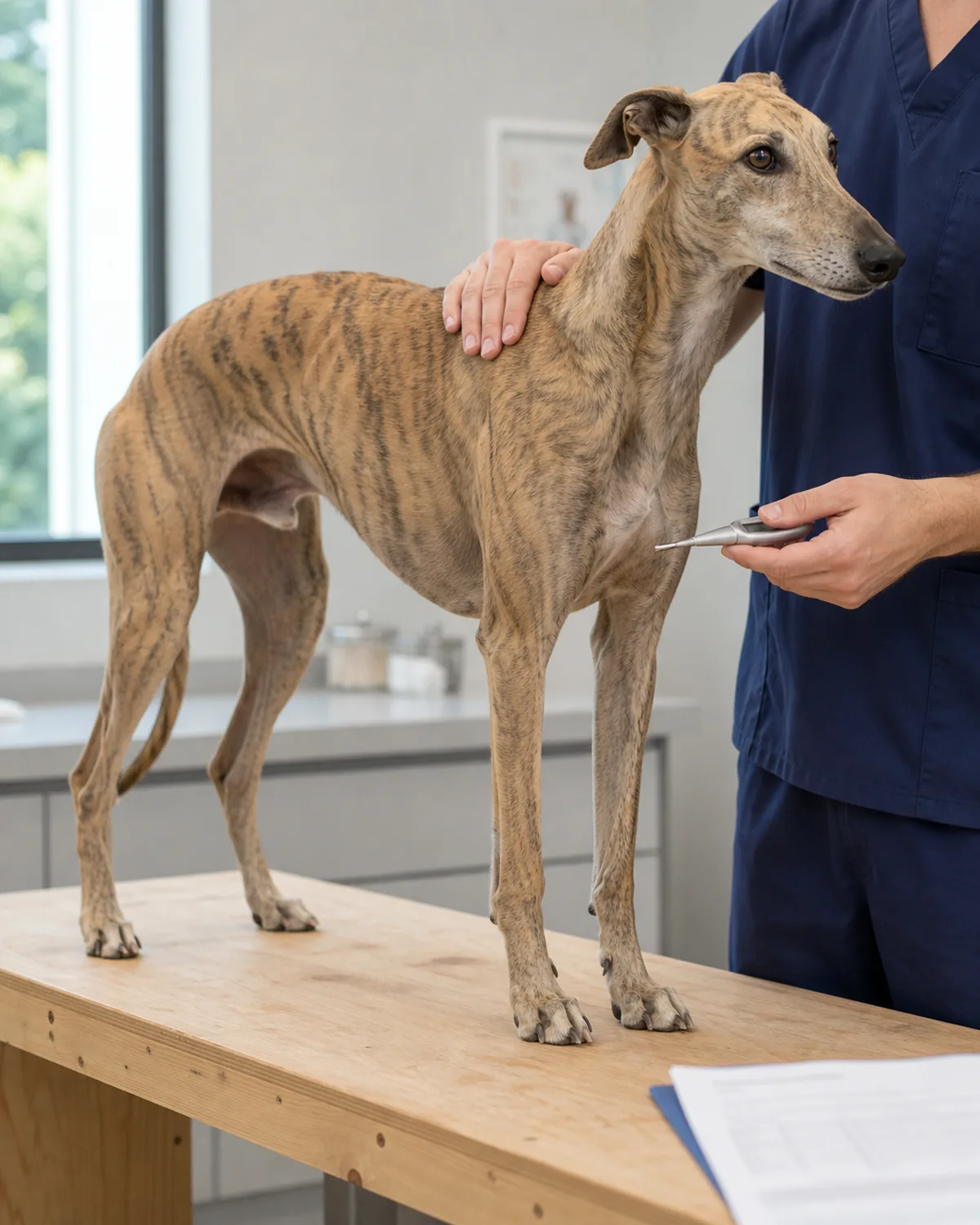
The cruelest part of heat stroke is that surface recovery does not equal real recovery. A dog who panted heavily, cooled down well in fifteen minutes, and is acting “almost normal” by evening can still develop disseminated intravascular coagulation, acute kidney injury, brain swelling, or rhabdomyolysis over the following twenty-four hours.
The clinical phrase is “delayed organ effects.” The practical takeaway is that any meaningful heat exposure earns a vet call even when the dog looks fine — twenty-four hours of vet observation is cheap insurance against a midnight ER bill.
Signs after the event that mean vet now
Specific signals after a heat event that mean vet now: dullness or off behavior, refusing food, refusing water, dark or tea-colored or cola-colored urine, very little urine for hours, persistent vomiting, no bowel movement for twenty-four hours, reluctance to stand, an off gait that persists. Any one of these — vet anyway.
A force-free or fear-free clinic will run liver and kidney panels, clotting times, and a core temperature curve, and they catch organ damage early when it is fixable.
The thesis of this whole guide one more time: prevention beats treatment by a margin that is not even close. The five minutes you spend on the heat-index check and the seven-second pavement test before stepping outside are worth the entire price of one ER night, which can run thousands of dollars. The dogs who make it through summer easily are not the lucky ones.
They are the ones whose owners measured the day, recalibrated the threshold, and took the boring grass walk at 5:30 a.m.
- Surface recovery is not real recovery — twenty-four-hour delayed organ effects are the silent risk.
- Specific signals after any heat event mean vet now: dullness, refusing water or food, dark urine, no urine, persistent vomiting, off gait.
- Prevention beats treatment — the boring 5:30 a.m. grass walk is the entire system working.
Jess Calloway edits Pawliqa, where she shares dog care, grooming, training, and new-owner tips — plus DIY and pet-friendly home ideas — for anyone who wants a happy, well-cared-for dog. As a dog mom to three very different dogs, she writes the honest, tested version of what actually works. This summer cool-down guide covers the heat-index map, the seven-second pavement test, the six early warning signs, the first-five-minutes emergency plan, and the twenty-four-hour follow-up that quietly saves dogs after the obvious crisis has passed. Every guide is image-led and reviewed for clarity, usefulness, image accuracy, and Pinterest-to-page alignment before it goes live. Visit the About page.