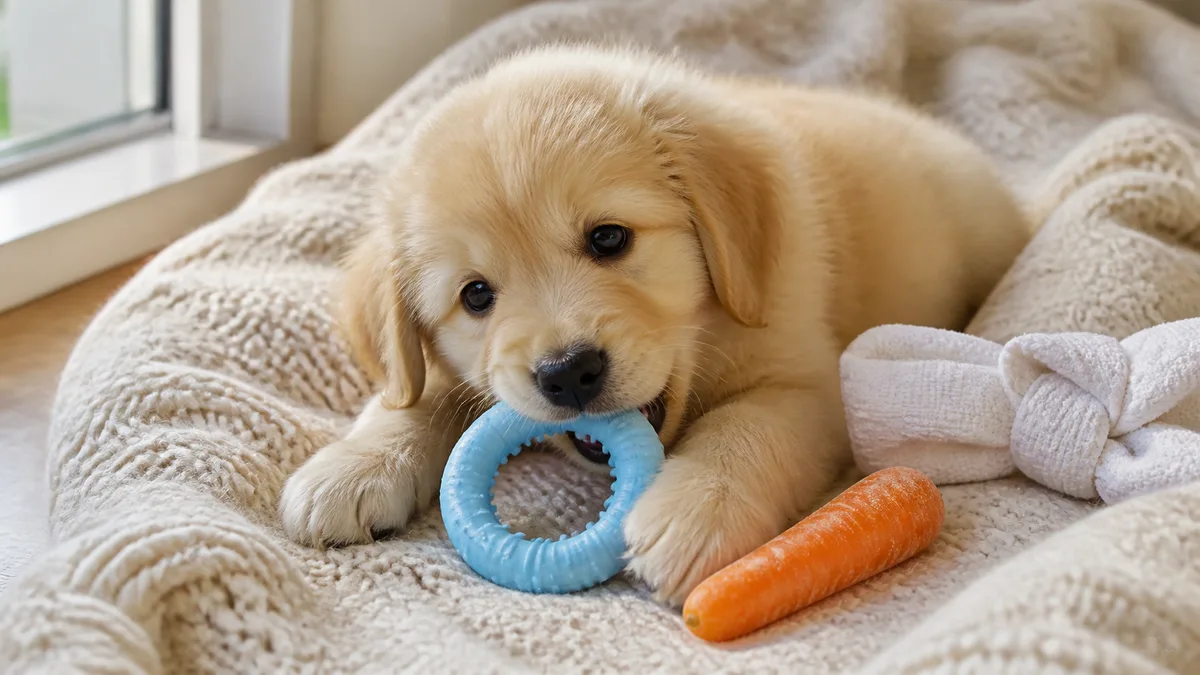

The new puppy checklist most owners build is forty items long and half wrong. Buy the right twelve and the first two weeks at home run on rails. Buy the wrong ten and you stack $300 of clutter she never touches.
My first puppy got the forty-item version: stroller, booties, eight treat flavors, a designer collar she outgrew in nine weeks. Roughly $340 of it sat unused inside a year. My next two puppies got the essentials version, and adapted faster.
Section thirteen is the skip list — seven popular items that quietly waste money. Read that one even if you skim the rest.
A smart new-puppy supply run is not a Pinterest haul — it is twelve right-sized essentials, a short skip list, and a fridge card with three phone numbers. Buy the right things once, in the right sizes, before pickup day, and the first 72 hours at home stay calm instead of chaotic. Here is the honest, room-by-room version.
- 1Start with the crate that sets the rules
- 2The two-bowl setup
- 3Puppy food that matches your pickup date
- 4Collar, harness, and leash from day one
- 5The ID tag mistake that doubles lost-puppy risk
- 6Bedding that survives teething safely
- 7Three chew categories every puppy needs
- 8Potty setup — cleaner plus outdoor system
- 9The grooming starter kit most owners buy backward
- 10First-aid kit plus three fridge numbers
- 11Training treats under the 10% calorie rule
- 12The car-ride setup for a calm pickup day
- 13The skip list — seven items that waste money
Start With the Crate That Sets the Rules for the First 90 Days
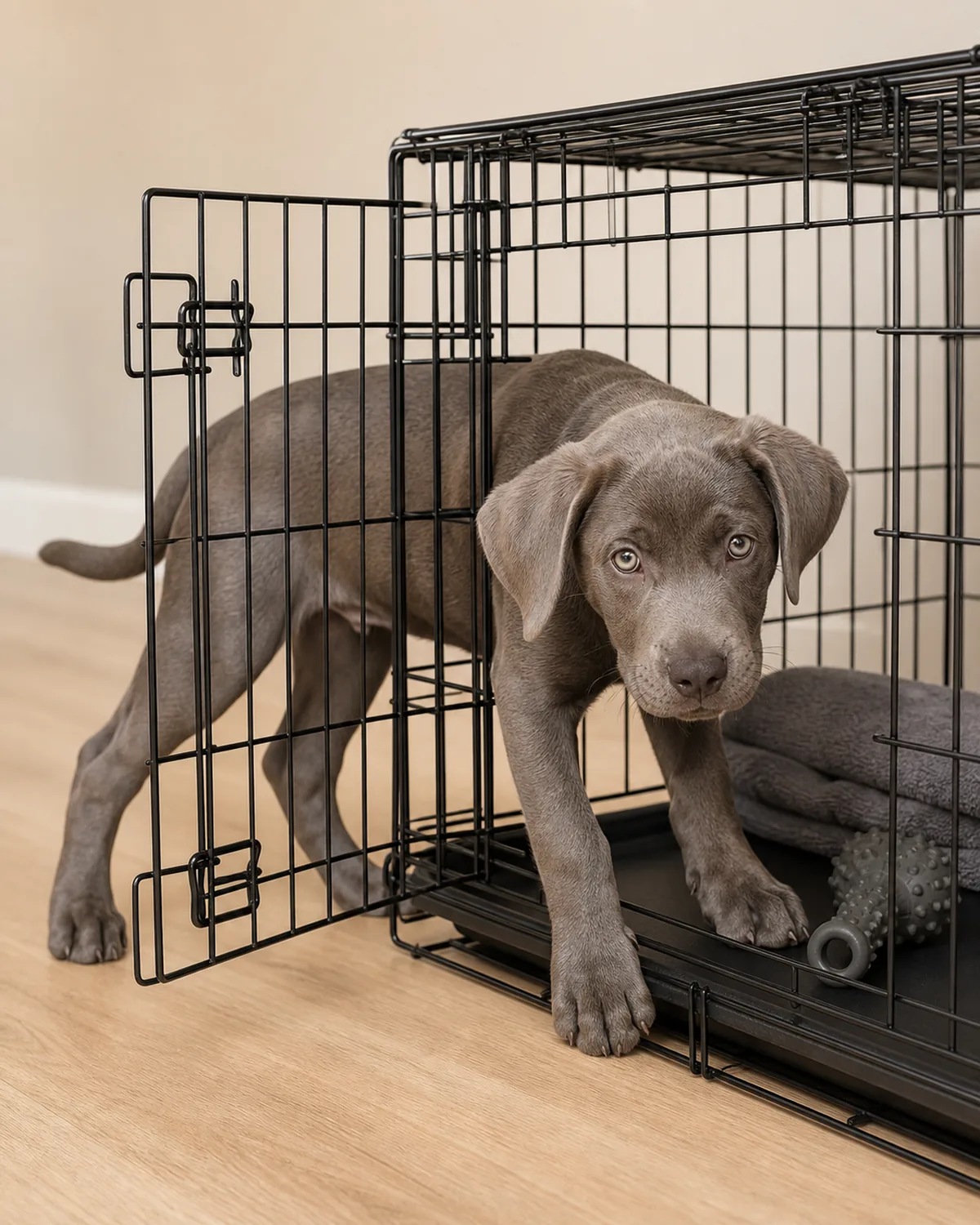
The crate is the single highest-leverage purchase on the entire list. It sets the structure for sleep, potty training, alone-time tolerance, and the first ninety days of household rules. Get the crate right and the other twelve items get easier; get it wrong and you fight every night for a month.
Size it to her adult weight, not her pickup weight. A plain unbranded wire crate with a divider panel lets you box off two-thirds of the space at week one and slide the panel back as she grows. She should be able to stand, turn, and lie flat — no bigger. Extra room becomes a bathroom corner inside three nights.
Skip the cute soft-sided crates and the wicker decorative crates for the first six months. She will chew them, she will pee through them, and you will be buying a wire one anyway by week three.
Crate placement on day one
Pick the corner before the puppy arrives. A low-traffic spot inside a room the family uses — a living-room corner, the side of the kitchen out of the walk path — beats both the bedroom (separation building too late) and the laundry room (isolation building too early). The corner you choose on day one is the corner she will associate with rest for the next decade.
- Buy adult-size with a divider panel, not puppy-size you replace at month four. One crate, two settings, full first year covered.
- Position it in a low-traffic corner where the family is visible but not constantly walking past. Den first, decor second.
- Pair the crate setup with a room-by-room puppy-proof walkthrough before pickup so the space around the crate is safe too.
The Two-Bowl Setup That Prevents Resource Guarding Later
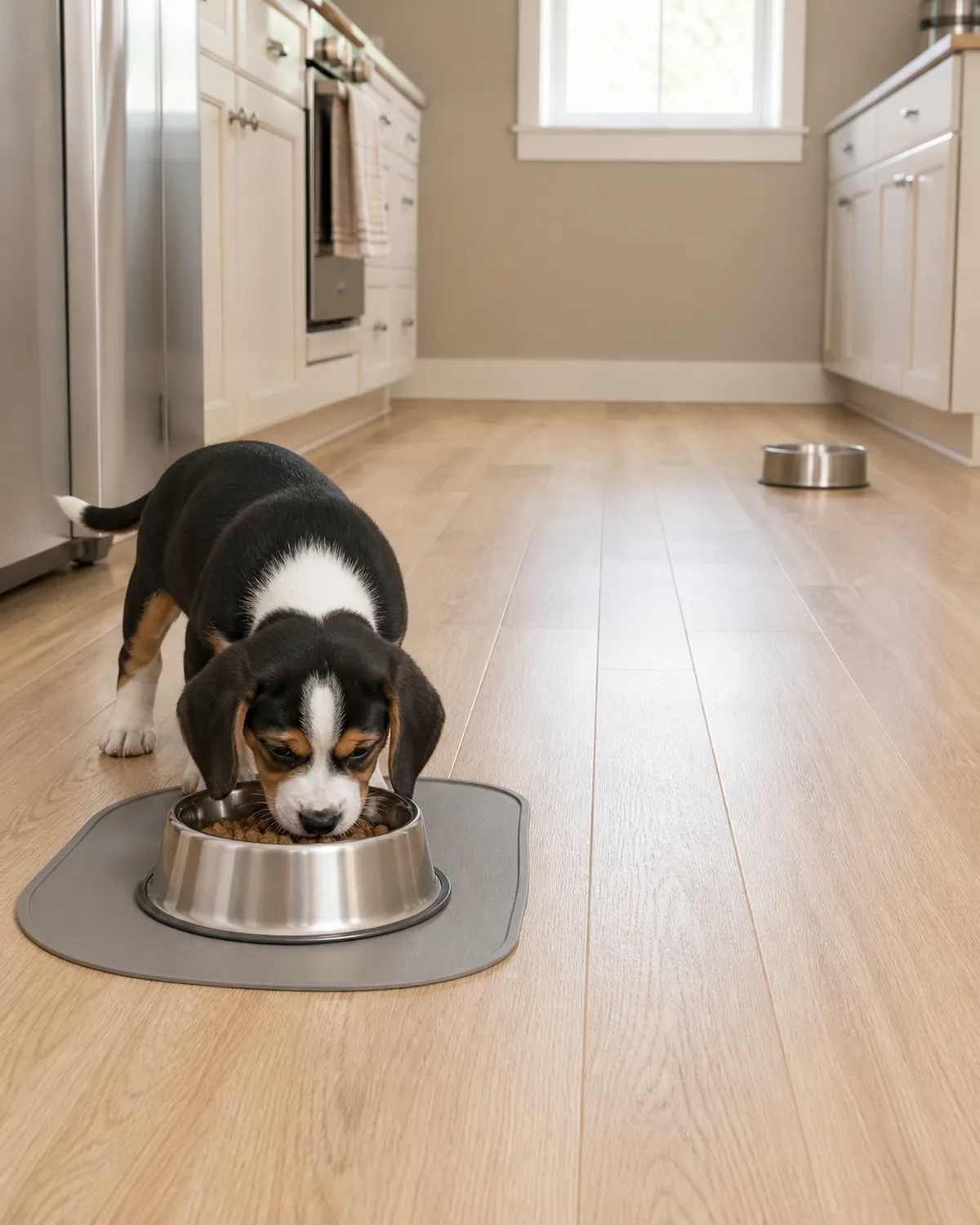
Two plain stainless steel bowls, one for food and one for water, sitting about a foot apart on a wipeable silicone mat. That is the whole purchase. The combined cost runs under fifteen dollars and the setup quietly heads off three problems most new owners do not see coming.
Stainless beats plastic and ceramic for one reason: it does not harbor bacteria in the micro-scratches that plastic develops within a month. Ceramic chips and the chip edges cut puppy tongues. Plastic also leaches into food at puppy chewing pressures and stains within weeks.
The two-bowl distance matters more than the brand. Touching bowls force the puppy to choose between food and water at the same body position, and that overlap is one of the earliest seeds of resource guarding. A foot of gap removes the choice entirely.
- Plain stainless steel, food and water in separate bowls a foot apart. Under $15 total and bacteria-free for life.
- Skip the elevated feeders for now. Recent large-breed research links them to bloat risk; floor-height is the safer default for the first year.
- A wipeable silicone mat under both catches every spill and rinses clean in 10 seconds. One mat lasts five years.
Puppy Food That Matches Your Pickup Date — Not Your Adult Plan
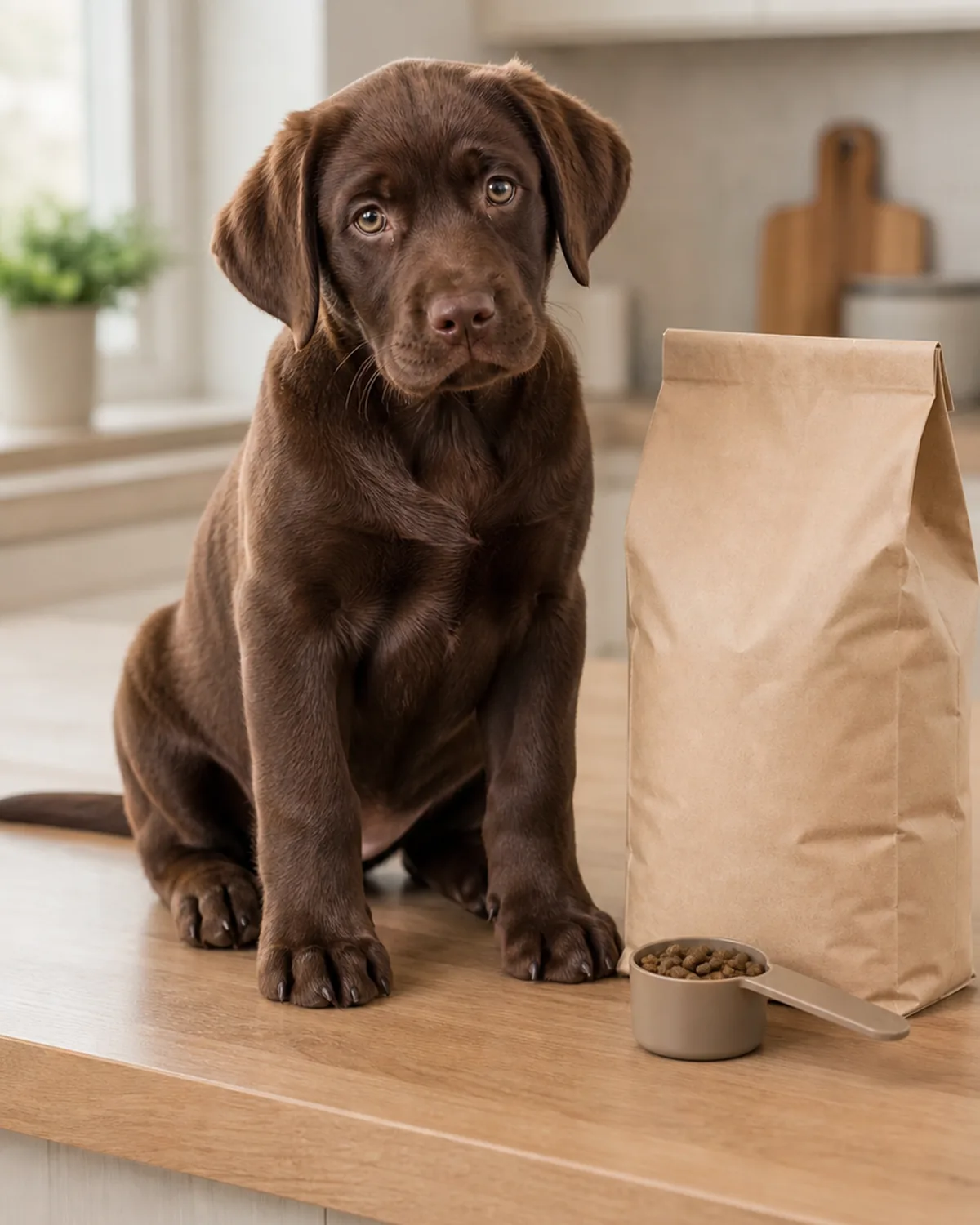
Buy a two-week supply of the exact food the breeder or rescue is currently feeding. Same brand, same formula, same kibble size. The pickup-week food decision is not your nutrition decision — it is your continuity decision, and the puppy’s gut will tell you within forty-eight hours whether the switch you were planning is one to slow down.
A diet change on day one stacks GI upset on top of the homesickness, the new environment, and the new water source. Even a “better” food causes diarrhea, dehydration, and a small puppy who suddenly will not eat. You want zero variables changing on pickup day except address.
Plan the food upgrade for week three at the earliest. Transition over seven days, twenty-five percent new mixed into seventy-five percent old, then half-half, then the reverse. If stools loosen, hold the current ratio for an extra day before advancing.
- Buy two weeks of the breeder or rescue’s exact current formula. Same kibble, same size, same brand. Continuity beats nutrition on day one.
- Plan the upgrade for week three or later. Seven-day transition with the 25-50-75 ratio. Loose stool = hold one extra day at the current step.
- Match the formula to her adult build category: small breed, medium breed, or large-breed puppy formula. Brand is your choice; category is the vet’s.
Pet retailers will gladly sell you a $400 starter haul of things your puppy will outgrow in six weeks or never use. Four small choices — made before pickup day — decide whether the supply run becomes a focused twelve-item list or a closet full of barely-used impulse buys.
Collar, Harness, and Leash: Why You Need All Three From Day One
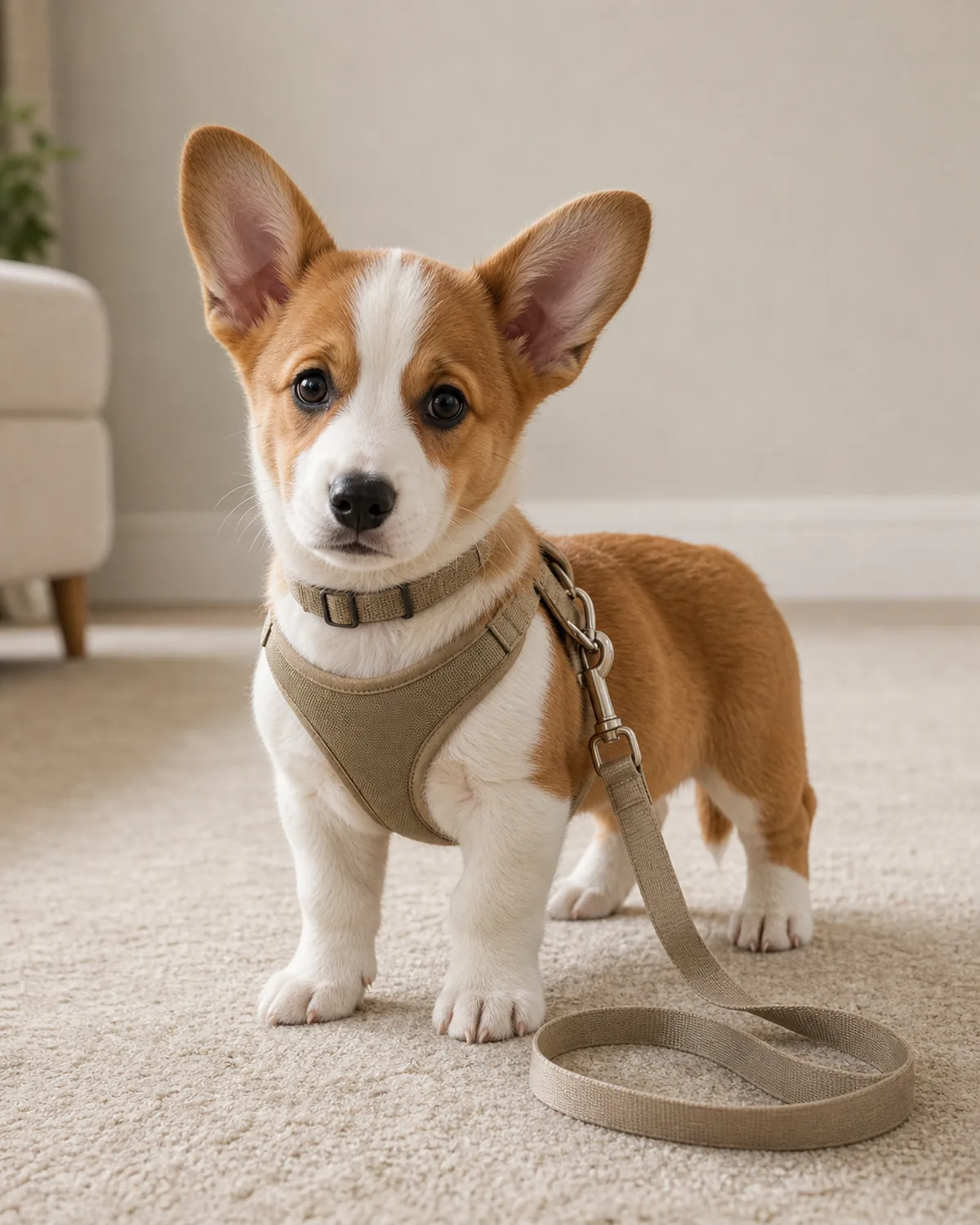
All three earn their place on day one, and each does a different job. The collar carries ID and lives on her twenty-four hours a day. The harness is what the leash clips to for every walk, vet trip, and car ride. The leash itself is the management tool for the entire first year.
The collar is a plain flat-buckle nylon, sized so two fingers slide flat between collar and neck. Skip the chain, choke, prong, and slip collars — none belong on a puppy under six months, regardless of how the pet store displays them.
The harness is a Y-front design that sits low across the chest, not a step-in design that crosses the throat. Y-front spreads pull pressure across the breastbone and away from the developing trachea. The leash is a plain six-foot flat lead, not a retractable. Retractables teach pulling and snap unpredictably.
Sizing for a growing puppy
Buy the collar and harness one size up from her pickup measurement and plan to replace both at month four. Adjustable straps cover roughly two months of growth at puppy speed, then she outgrows the adjustment range. Cheap-now plus replace-at-four beats expensive-now plus does-not-fit-by-twelve-weeks every time.
- Plain flat-buckle nylon collar 24/7. Two-finger fit between collar and neck. Skip chain, choke, prong, and slip collars for under-six-month puppies.
- Y-front harness, not step-in. Spreads pull pressure across the breastbone and protects the developing trachea on every walk.
- Plain six-foot flat leash. Skip the retractable — it teaches pulling, snaps unpredictably, and trains the wrong reflex on day one.
The ID Tag Mistake That Doubles Your Lost-Puppy Risk

The mistake costs about three dollars and doubles the time it takes to recover a lost puppy. An engraved ID tag with your current phone number, riveted or split-ring attached to her flat collar before she walks out of the breeder’s house, is the difference between a one-hour return and a multi-day shelter intake.
The mistake is putting the puppy’s name on the tag. A name lets a stranger call her over, build trust, and decide to keep her. Two phone numbers and the word “Reward” — no name, no address — gives the finder one job and one contact path. The recovery rate on name-free tags runs noticeably higher in shelter data.
Microchip status gets verified at the first vet visit, and the registration gets updated to your contact info the same week. A microchip with the breeder’s old phone number from three years ago is functionally the same as no chip at all.
Belt-and-suspenders tracking
For active families or first-time owners, a small GPS or AirTag-style tracker on a separate harness attachment doubles the recovery odds again. The tracker is not a substitute for the engraved tag — strangers who find a loose puppy read tags, not Bluetooth signals — but it shortens the search radius dramatically when she slips out of a backyard or off-leash zone.
- Engraved tag on the collar before pickup. Two phone numbers plus the word “Reward.” Skip the puppy’s name on the tag.
- Verify microchip status at the first vet visit and update registration to your contact info the same week.
- Riveted or sturdy split-ring attachment. Jingly S-hook attachments fall off in tall grass and that is exactly when she gets lost.
Bedding That Survives Teething Without Becoming a Choking Hazard

Skip the plush dog bed for the first six months. The decorative bed you photographed for Instagram will be shredded inside three weeks, and the stuffing she swallows is the second most common foreign-body obstruction in puppies under a year. The vet bill on that surgery runs three to five thousand dollars.
Use two or three plain thick folded bath towels stacked inside the crate instead. They wash in any machine, they survive any accident, they cost almost nothing to replace, and there is no stuffing to swallow. Layered towels also let you pull the top one off when soiled without disrupting the den structure.
When the upgrade to a real bed makes sense
The upgrade to a real orthopedic bed waits until the puppy reliably stops mouthing soft objects, which usually lands somewhere between six and nine months. Before then, the towel stack is the right answer for the same reason the wire crate is the right crate — durability and zero ingestion risk.
Pair the bedding plan with the room-level safety pass: vacuum once before pickup so loose threads, sock fluff, and tiny floor debris are gone — the room-by-room puppy-proof walkthrough covers exactly which floor-level hazards to clear in each room.
- Folded plain bath towels in the crate, not a plush bed, for the first six months. Zero stuffing means zero foreign-body obstruction risk.
- Towel rotation: two or three towels stacked, peel off the soiled top layer, fresh stack ready within thirty seconds at midnight.
- Upgrade to a real orthopedic bed at six to nine months, once the puppy reliably stops mouthing soft objects.
The difference between a $180 focused supply run and a $480 closet full of gadgets she will never use is one of these sixteen lines. Read both columns once before you click checkout, then again at the pet-store entrance before the impulse aisle.
Always Do
- Buy an adjustable-divider crate sized for her adult weight, not puppy weight — the divider does the resizing.
- Get two stainless-steel bowls (food and water) and place them about six feet apart so water stays clean.
- Use a flat-buckle collar with a quick-release clasp and two fingers of room at her neck.
- Have the ID tag engraved with your phone number before pickup — it ships home on her collar day one.
- Pre-load a paper fridge card with three numbers: your vet, ASPCA 888-426-4435, Pet Poison 855-764-7661.
- Buy enzymatic cleaner BEFORE pickup, not after the first accident soaks into the rug at 11 p.m.
- Keep training treats under ten percent of her daily calorie budget — small soft pieces, broken smaller.
- Use a crash-tested carrier or seat-belt-strapped soft carrier for the pickup-day car ride home.
Never Don’t
- Never buy a retractable leash for a puppy — it teaches pulling and snaps fingers on the rewind.
- Never buy a prong, choke, or shock collar for a puppy — flat-buckle plus Y-front harness only.
- Never buy a stroller before she has even worn a leash — revisit the idea at month six, maybe.
- Never buy puppy booties for a normal climate — her pads need to develop, not get wrapped in fleece.
- Never switch puppy-food brands inside the first thirty days — brand consistency keeps her stool firm.
- Never buy elevated bowls for a small-breed puppy — floor height is correct, raised bowls strain her neck.
- Never use human shampoo or baby wipes meant for human skin — pH is wrong, irritates her coat.
- Never sign up for a subscription box month one — you do not know yet what she likes or chews safely.
The Three Chew Categories Every Puppy Needs (And the One That’s Banned)
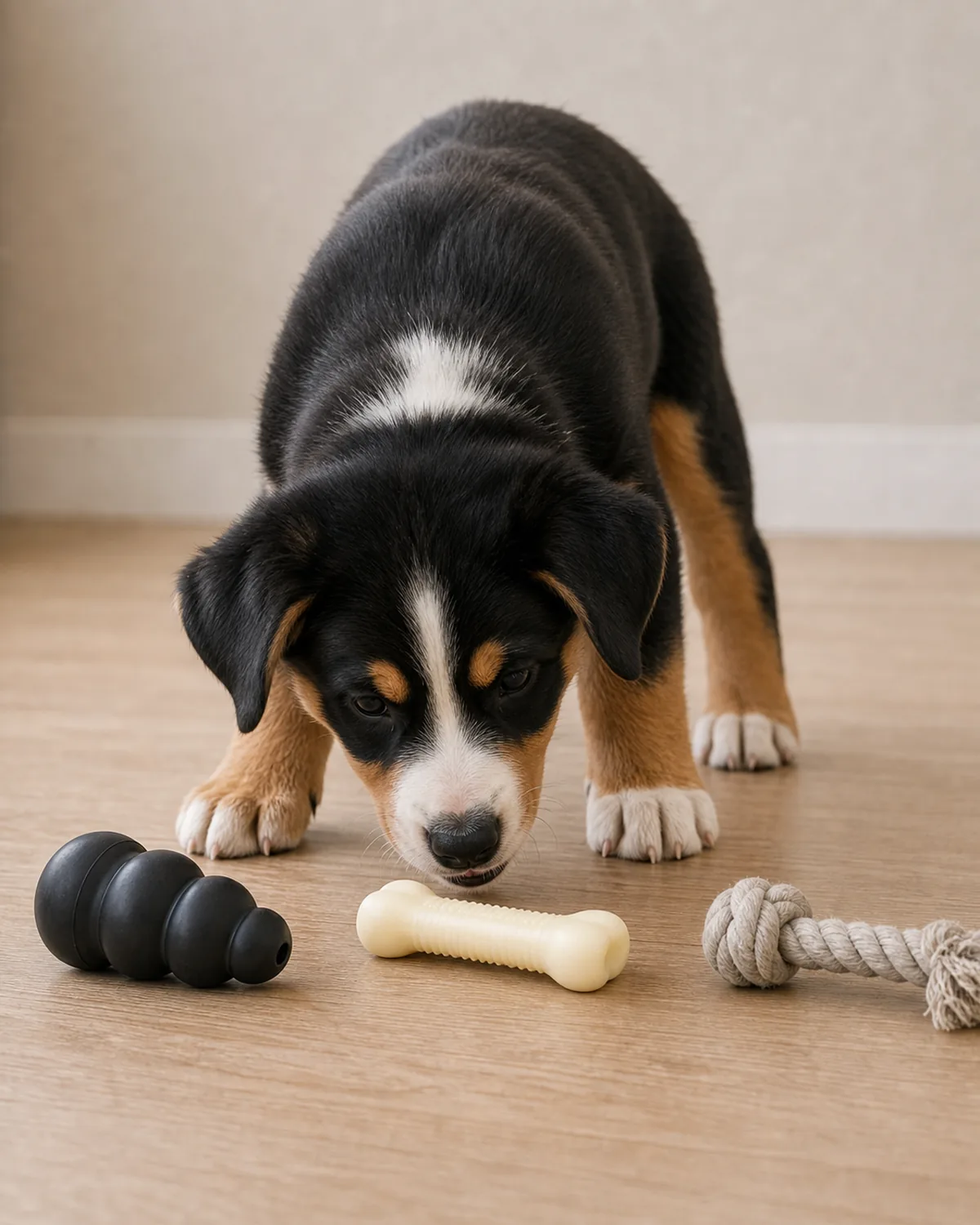
Puppy teething runs from about three months to seven months and the urge to chew is constant. Three chew categories handle the load without a vet visit. The fourth category — the one that does not belong in the basket — is what most new owners buy first.
Category one is a rubber food-stuffable chew, sized for puppy jaws. Frozen with a smear of plain wet food inside, it occupies twenty minutes and soothes teething gums at the same time.
Category two is a rope or canvas tug for interactive chewing with you, never left unsupervised because shredded threads cause gut blockages. Category three is a softer rubber teether for solo chewing, replaced when corners start fraying.
The banned category is bones, antlers, hard nylon, and anything you cannot dent with a thumbnail. Vet dental data consistently shows these as the leading cause of puppy tooth fractures. The fracture costs about eighteen hundred dollars to repair under anesthesia. Thumbnail dent test or it does not enter the house.
The chew rotation rhythm
Three to five chews live in a basket, and only two come out at a time. The other three rotate back in a few days later, and the recycled novelty is what keeps interest up without buying more. Wash the stuffable rubber chew weekly in warm soapy water. Replace the soft rubber teether the moment a corner frays past a fingernail edge.
- Three categories in rotation: stuffable rubber, supervised rope/canvas, solo soft rubber teether. Three to five items total, rotated weekly.
- Banned: bones, antlers, hard nylon, hooves. If you cannot dent it with a thumbnail, it cracks puppy teeth. Vet dental bill = ~$1,800.
- Rope and canvas chews are interactive-only, never unsupervised. Shredded threads cause gut blockage at the same rate as bedding stuffing.
Potty Setup: Enzymatic Cleaner Plus an Outdoor System
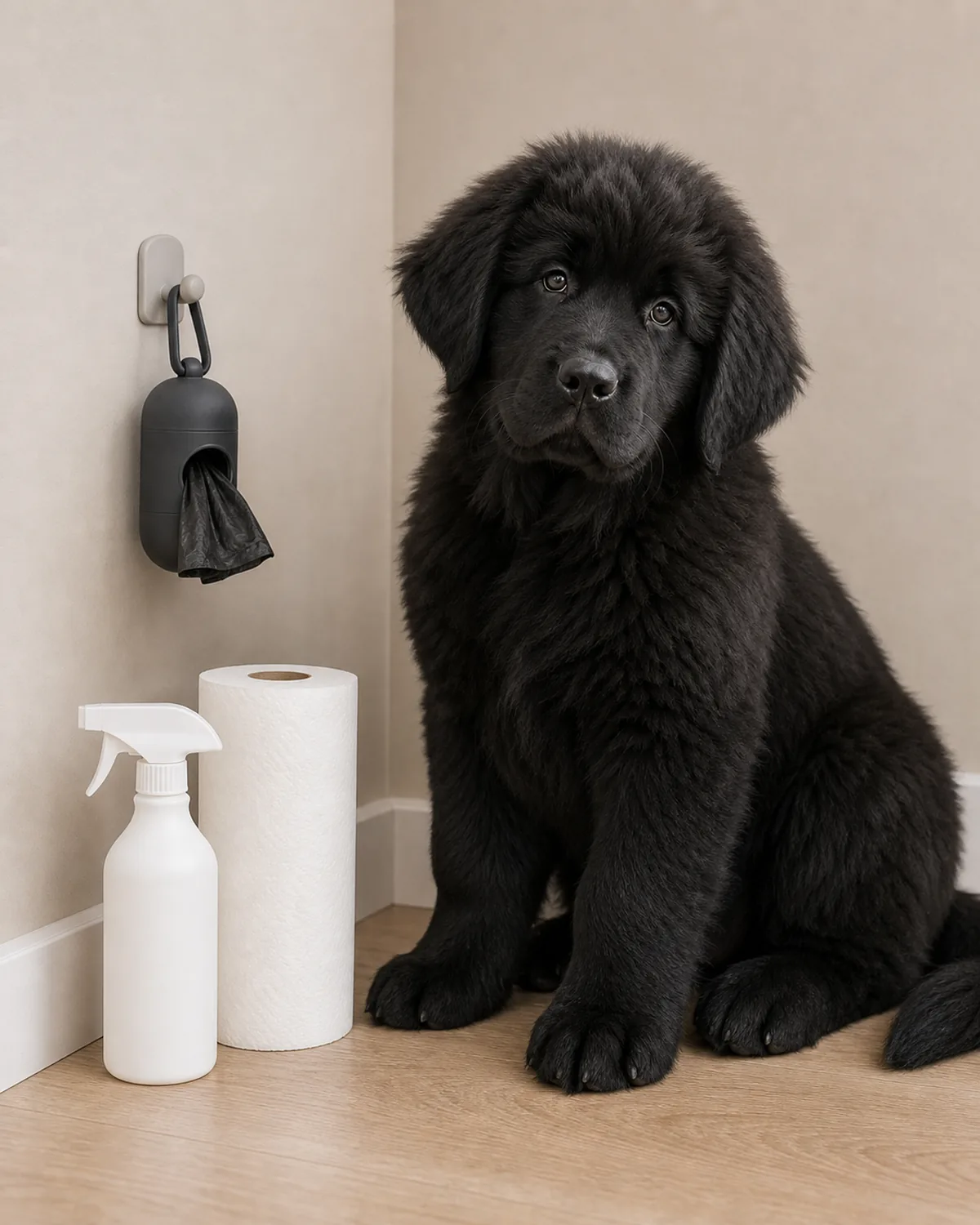
The potty setup is two purchases and one schedule decision. The enzymatic cleaner is non-negotiable from day one because conventional cleaners leave behind the protein residue that signals “bathroom spot” to the puppy nose. She will return to the exact same square foot until that residue is broken down.
Buy a plain unbranded enzymatic cleaner sized at least a half gallon. You will use it more than you think for the first eight weeks. Skip ammonia-based cleaners entirely — ammonia smells like urine to a puppy and actively trains her to keep going on the same spot.
The outdoor system is a designated potty zone within twenty feet of your door, ideally not the main lawn. Same spot every trip. Treats hit her mouth within two seconds of the last drop, not after she comes back inside. The two-second window is what locks the location-and-reward association.
Cleanup choreography indoors
When an accident happens — and it will, daily, for the first six weeks — pick the puppy up calmly, take her outside to the potty zone, then come back in and clean. No scolding. No nose-to-the-spot. Saturate the area with the enzymatic cleaner, blot, let it air dry. Skipping the air-dry step leaves the surfactant active and she will re-mark the same spot.
- Enzymatic cleaner, half gallon minimum, from day one. Conventional cleaners leave the scent that re-trains the same spot. Ammonia is worst.
- Designated outdoor potty zone within 20 feet of the door. Same spot every trip. Treats within two seconds of the last drop, outside.
- Skip indoor pee pads unless apartment-living forces them. Pads teach indoor potty as acceptable and double the housetraining timeline.
The Grooming Starter Kit Most Owners Buy Backward
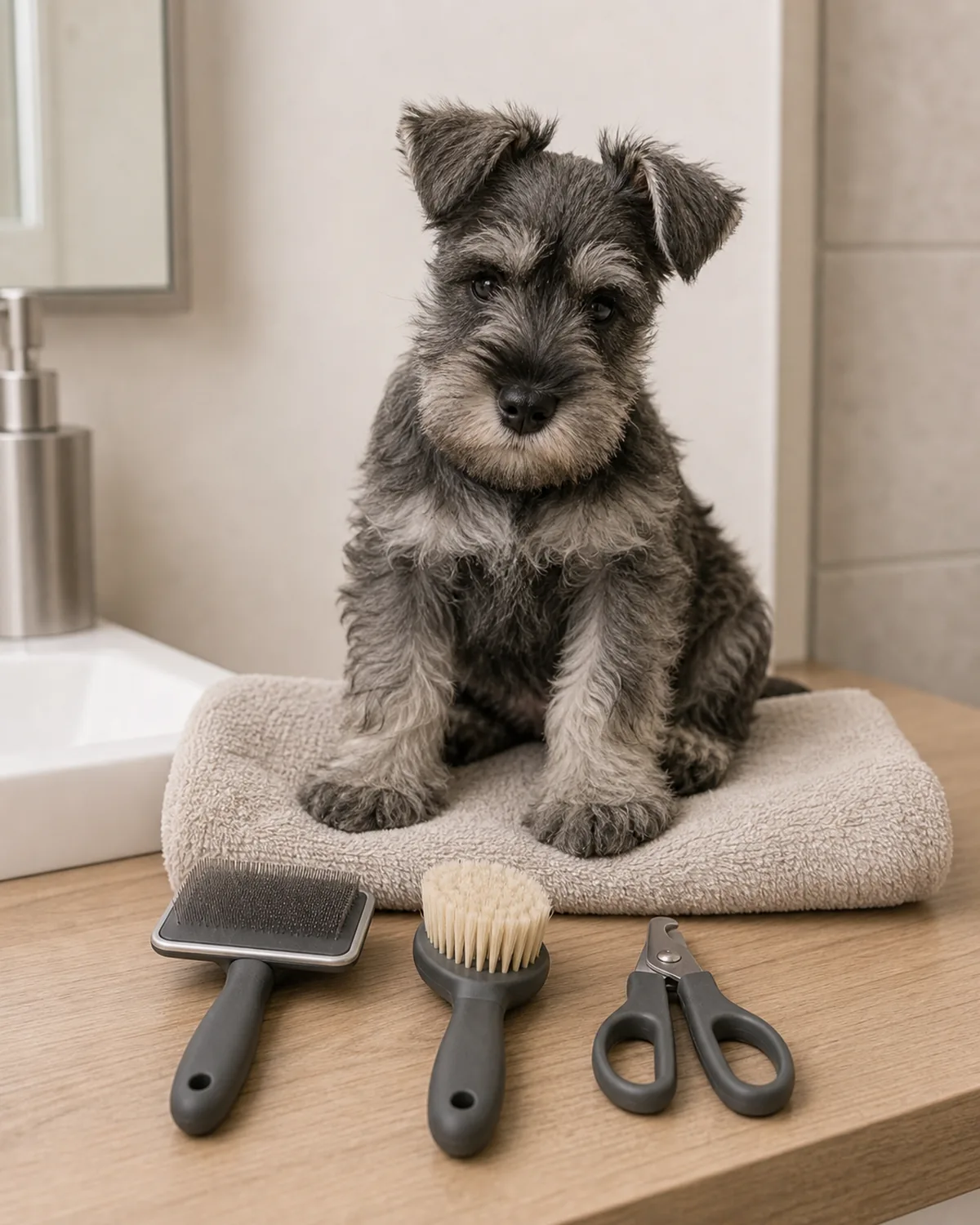
Most new owners buy the bath kit first and the brush last. Backward. Brushing happens four to six times a week for her entire life. Bathing happens once every four to six weeks at most. The starter kit should match the frequency, not the romance of the puppy-bath photo.
The four-item starter kit is a slicker brush sized for her coat type, a pair of small puppy nail clippers (or a quiet grinder if she tolerates motors), a tear-free puppy shampoo, and a microfiber drying towel. Total cost runs under fifty dollars. Everything else — detangling spray, conditioner, blow dryer attachment, paw balm — waits until you know whether she actually needs it.
The brush is the daily-handling tool, not the grooming tool. Two minutes a day for the first month builds the tolerance for every future nail trim, ear clean, and vet exam. If she already resists the brush, the full guide for a brush-hating dog walks through the desensitization protocol that resets the association in about three weeks.
- Four-item starter kit: slicker brush, small puppy nail clippers or quiet grinder, tear-free puppy shampoo, microfiber drying towel. Under $50 total.
- Brush daily for two minutes from week one. The brush is the handling tool, not the grooming tool, and it codes calm body-touch for life.
- Skip the dryer, conditioner, detangling spray, and paw balm at the starter stage. Add only what her actual coat proves it needs.
New Puppy Checklist Quick Card
Must-buy — 12 essentials
- Adjustable-divider crate sized for her adult weight.
- Two stainless-steel bowls, food plus water, six feet apart.
- Puppy food, one trusted brand, four-week supply.
- Flat-buckle collar with quick-release, two-finger fit.
- Y-front puppy harness, sized for current weight.
- Six-foot flat leash, no retractable.
- Engraved ID tag with your phone number, ready day one.
- Washable puppy bed, no stuffing she can rip and swallow.
- Three chew categories: soft, rubber, and edible long-lasting.
- Enzymatic cleaner, gallon size, in the cabinet before pickup.
- Basic first-aid kit: gauze, vet wrap, tweezers, styptic powder.
- Paper fridge card with three numbers, taped before pickup.
Right-size cheat sheet
- Crate: sized for adult weight, divider for puppy now.
- Collar: two fingers fit, check fit weekly.
- Harness: Y-front puppy fit, room for one finger.
- Leash: six-foot flat, no bungee, no retractable.
- Bowls: small mouth for tiny breeds, low height.
Skip list — do not buy these
- Retractable leash, teaches pulling and snaps fingers.
- Prong, choke, or shock collar — never for puppies.
- Stroller before she has ever walked on a leash.
- Costume or holiday outfit before month six.
- Heated bed, puppies overheat fast, body heat sufficient.
- Human shampoo or baby wipes meant for human skin.
- Puppy booties for a normal climate, pads need to develop.
- Subscription box, month one, before you know her taste.
3-number fridge card — tape before pickup
- Your vet’s daytime number plus 24-hour emergency line
- ASPCA Animal Poison Control 888-426-4435
- Pet Poison Helpline 855-764-7661
PAWLIQA · NEW DOG OWNERS
First-Aid Kit Plus Three Numbers on the Fridge Before Pickup
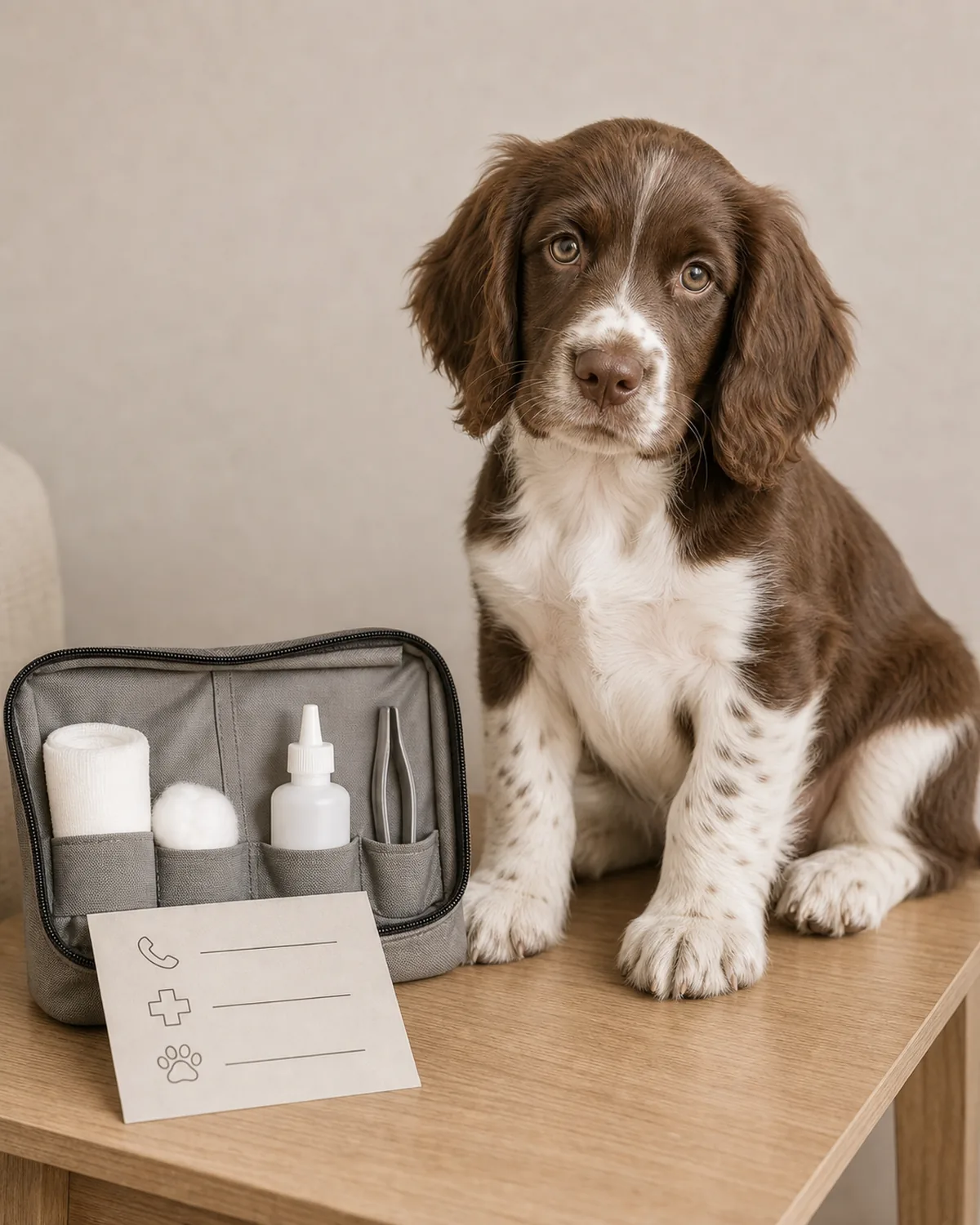
The first-aid kit is eight items in a single zipped pouch tucked under the kitchen sink. The kit is not a substitute for a vet — it is the bridge to the vet for the twenty-minute window between the incident and the clinic call. Eight items, no substitutions, repacked the same day each is used.
Sterile gauze pads, a self-adhesive vet wrap, blunt-tip scissors, a digital thermometer, sterile saline eyewash, hydrogen peroxide (induce-vomiting use only, under vet direction), a small tube of antibiotic ointment for minor scrapes, and a pair of nitrile gloves. Cost under twenty-five dollars, lifetime use.
Any first-aid event larger than a surface scrape gets a phone call before any home action. Nothing in this kit replaces the call. The kit only buys you the time to make it.
The three fridge numbers go on a magnet before the puppy walks in: your day vet, the twenty-four-hour emergency vet, and ASPCA Animal Poison Control at 888-426-4435 with Pet Poison Helpline at 855-764-7661 as backup.
- Eight-item kit in one pouch: gauze, vet wrap, blunt scissors, thermometer, saline eyewash, hydrogen peroxide, antibiotic ointment, nitrile gloves.
- Three fridge numbers on a magnet before pickup: day vet, 24-hour emergency vet, ASPCA 888-426-4435 with Pet Poison 855-764-7661 as backup.
- No home treatment for anything bigger than a surface scrape. Call first, treat second. The kit buys you 20 minutes, not a diagnosis.
Training Treats That Stay Under the 10% Daily Calorie Rule
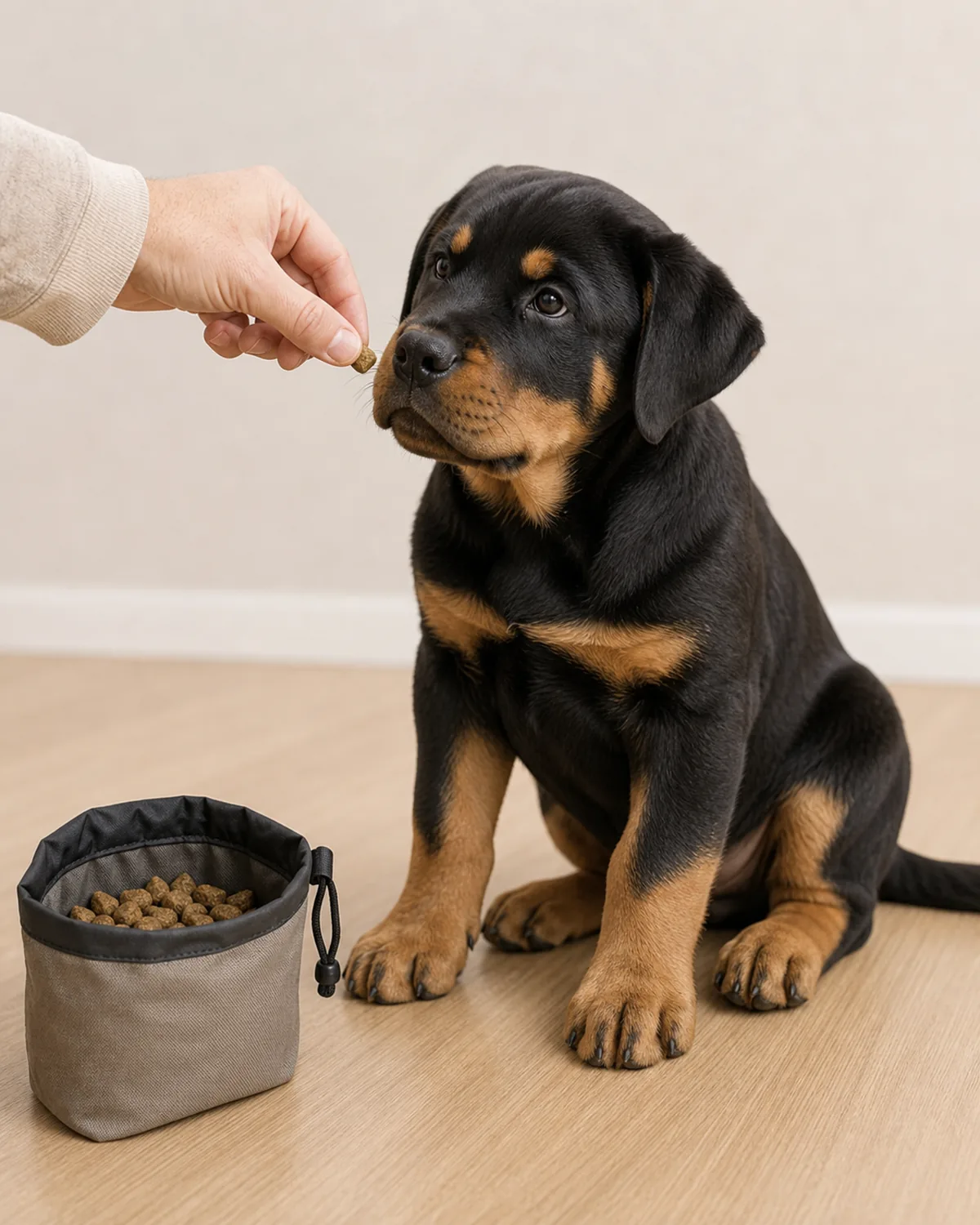
Treats are the most over-bought line on the entire checklist. The single rule that prevents both obesity and the eight-flavor cabinet overflow: treats stay under ten percent of her daily calorie budget. For an eight-week puppy on roughly three hundred calories a day, that is about thirty calories of treats — closer to a dozen small soft pieces than the bag suggests.
Three treat tiers cover every training scenario. Low value is plain kibble from her own bowl, used for known cues at home.
Medium value is a small soft store-bought training treat, used for new cues and mild distraction work. High value is a tiny pea-sized piece of plain cooked chicken or freeze-dried liver, reserved for vet visits, first car rides, and major fear thresholds.
Pea-sized is the size standard, not the bag-recommended portion. Bigger pieces stall the training rhythm because she has to chew instead of resetting for the next rep. Soft beats crunchy for the same reason.
Treat pouch logistics
A plain clip-on treat pouch on your hip during the first two months turns every household interaction into a training rep. Loaded with kibble in the morning, refilled at lunch, off your hip when you sit down to eat.
The pouch is the reason rewards land in the two-second window every single time, instead of “wait, let me get a treat from the kitchen” — a delay that erases the training value entirely.
- 10% daily calorie cap on all treats combined. For an 8-week puppy on ~300 kcal/day, that is ~30 kcal of treats — about a dozen small soft pieces.
- Three tiers: low (her own kibble), medium (small soft training treats), high (pea-sized cooked chicken or freeze-dried liver for vet/scary contexts).
- Pea-sized pieces only. Bigger pieces stall training rhythm because chewing breaks the rep cadence. Soft beats crunchy for the same reason.
The Car-Ride Setup That Makes Pickup Day Calm
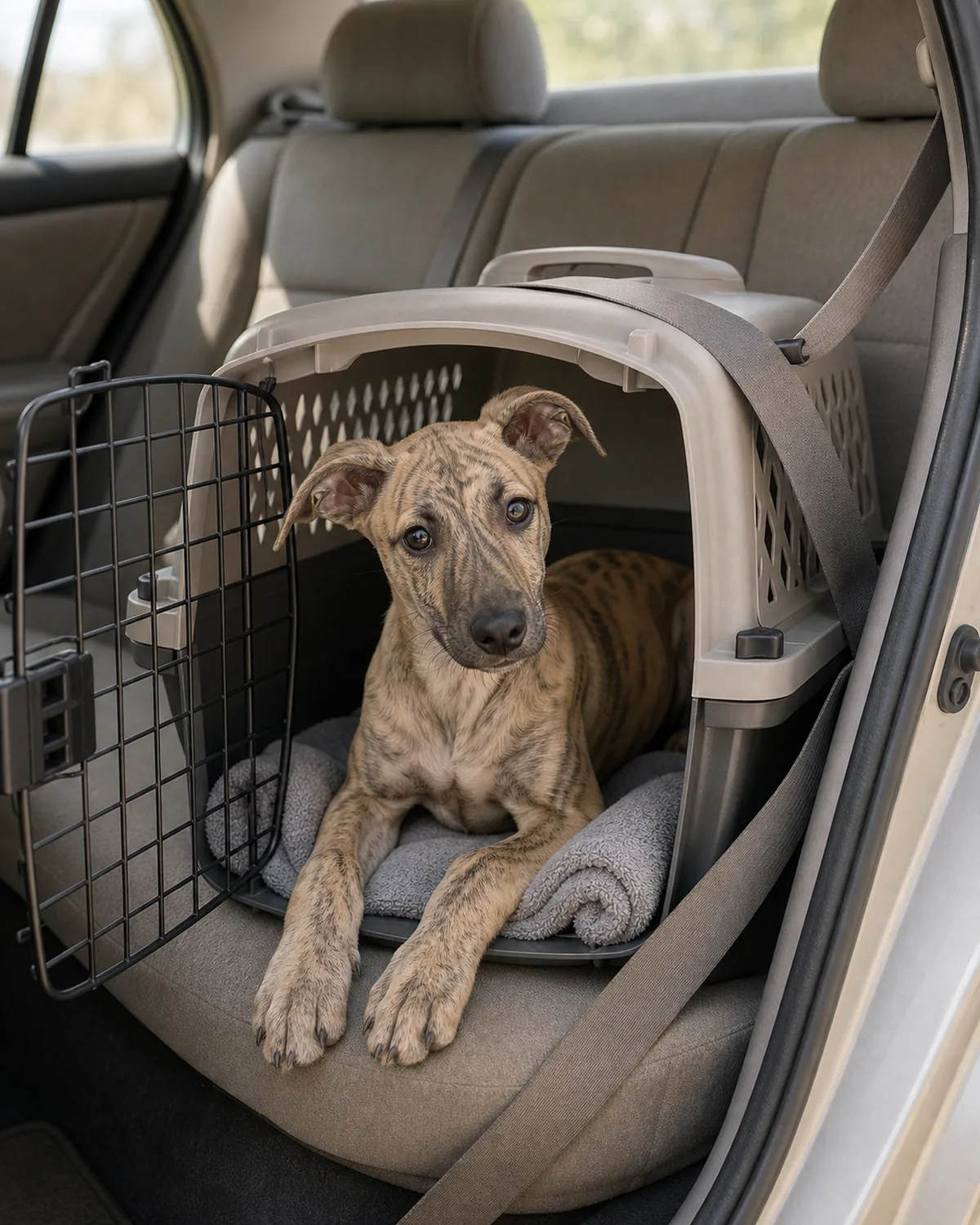
Pickup-day transport gets one purchase and one rule. The purchase is a plain unbranded hard-sided carrier sized for her current weight, not the adult crate she will graduate into. A puppy in a too-large carrier slides on every turn and the slide stacks motion sickness onto the new-environment stress.
Line the carrier with a plain rolled towel and ask the breeder or rescue to rub a worn t-shirt of theirs against the whelping bedding the morning of pickup. That scented towel rides home with her. The familiar smell drops cortisol in the first ten minutes far more reliably than any pheromone spray on the market.
The rule is the carrier goes in the rear passenger footwell, strapped down. Not on a lap, not on the front seat, not loose in the back. Front-seat airbags are genuinely fatal for a small puppy in a sudden stop, and a lap-held puppy becomes a projectile. Skip food for the two hours before pickup so the stomach is empty for the ride.
- Hard-sided carrier sized for current weight, plain unbranded, with a divider or rolled towel filler to prevent sliding on turns.
- Scented towel from the breeder’s whelping room, rubbed against a worn t-shirt of theirs that morning. Cortisol drops faster than any spray.
- Carrier in the rear passenger footwell, strapped down. Empty stomach for two hours pre-ride. No detours on the drive home.
The “Skip List” — Seven Popular Puppy Items That Waste Your Money

These seven show up in nine out of ten online puppy checklists and earn back almost none of their cost in the first year. Each gets the one-line reason it does not belong on the starter list. Add them later only if her actual lifestyle proves the need.
The puppy stroller. Useful for one-percent of owners (limited-mobility households, intentional senior-dog future planning). Almost never used in year one and storage cost outlasts use cost. The fleece booties. Outgrown in three weeks, refused by most puppies, and her paw pads toughen naturally with normal sidewalk walking.
The designer collar over $40. She outgrows it before her first birthday. Buy a $6 plain flat-buckle now, a real adult collar at month nine. The eight-flavor treat sampler. You will identify her two go-to flavors inside a week and the other six go stale. Buy two flavors in small bags first.
Comfort gadgets that almost never earn their cost
The self-cooling gel mat. Most puppies ignore it. Shade plus tile floor plus a wet towel costs nothing and works better. The enrichment puzzle over $80. She destroys the expensive ones at the same rate as the $12 ones. Start cheap, upgrade only after she proves she will use them. The matching feeding-station decor set. The two-bowl setup in section two does the entire job for under $15.
- Seven money-pits to skip on the starter list: stroller, booties, $40+ designer collar, 8-flavor treat sampler, cooling gel mat, $80+ puzzle, decor feeding station.
- Add each only if her actual lifestyle proves the need at month three or later. Year-one buy-then-store cost beats year-one usefulness on all seven.
- The skip list is not anti-spending. It is sequence — buy essentials first, observe her real needs for 90 days, then upgrade with data.
Jess Calloway edits Pawliqa, where she shares dog care, grooming, training, and new-owner tips — plus DIY and pet-friendly home ideas — for anyone who wants a happy, well-cared-for dog. As a dog mom to three very different dogs, she writes the honest, tested version of what actually works. This new-puppy-checklist guide covers the twelve right-sized essentials, the adjustable-divider crate, the two-bowl setup, the brand-consistent puppy food, the flat-buckle collar plus Y-front harness plus six-foot leash, the engraved ID tag ready day one, the washable teething-safe bed, the three chew categories, the enzymatic cleaner before the first accident, the training treats inside the ten-percent calorie rule, the seven-item skip list, and the three-number fridge card every new owner needs on the door before pickup. Every guide is image-led and reviewed for clarity, usefulness, image accuracy, and Pinterest-to-page alignment before it goes live. Visit the About page.